People of AI: Ada Lovelace
Mathematician. Daughter of the poet Lord Byron. Her mother raised her on numbers, hoping to keep the poetry out. It came through anyway. Ada called her way of thinking "poetical science."
She was curious about mathematics, music, poetry, and the relationship between symbols and numbers.
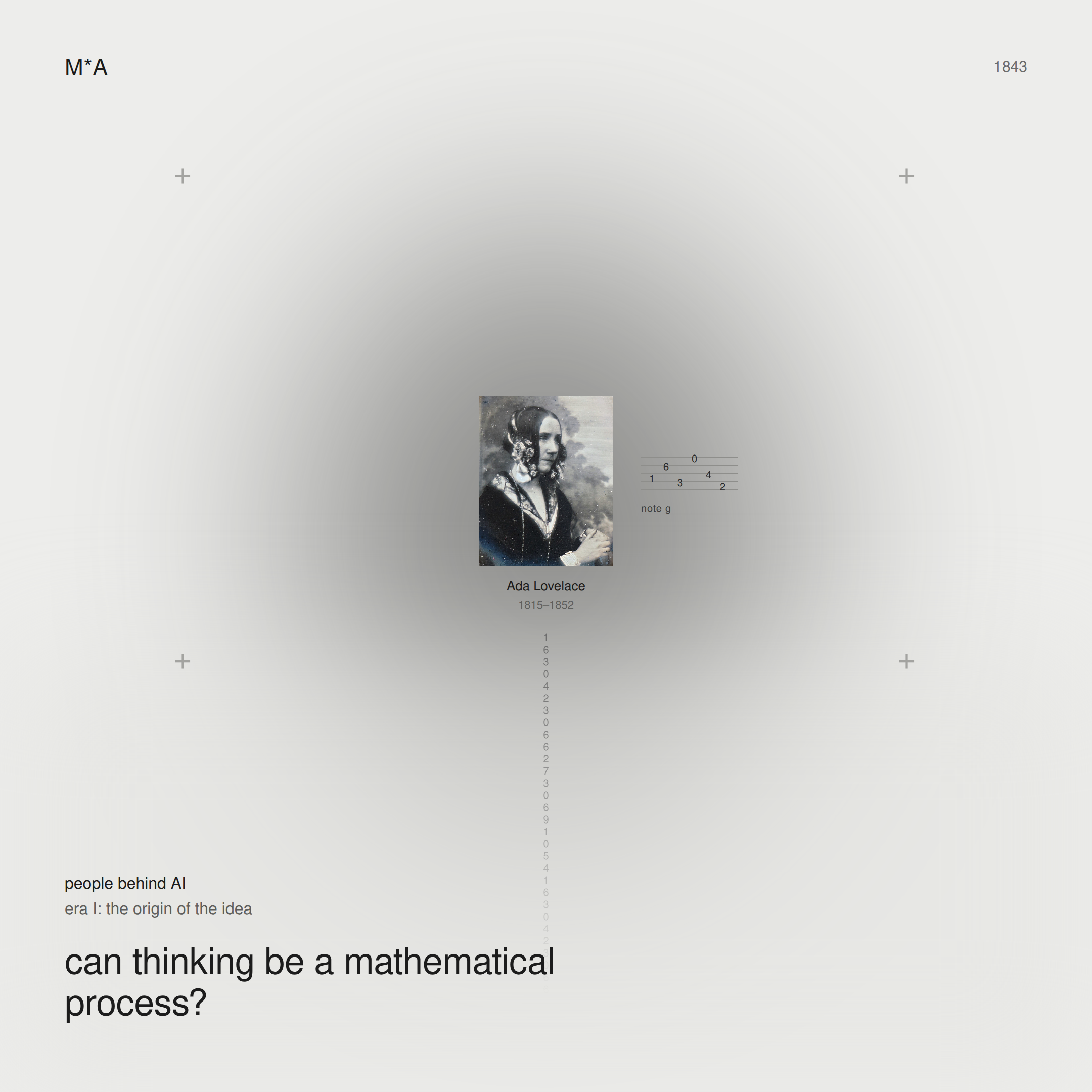
In 1843 she translated an article about Charles Babbage's Analytical Engine, a machine that was never built. Her notes grew three times longer than the article itself. Inside them was an algorithm for calculating Bernoulli numbers, that was often called the first computer program.
But what Ada saw was past the numbers; if a symbol can stand for anything, a machine can work with anything. She imagined it composing music.
Imagine; A note is a symbol, just like a number. Give the machine the rules of harmony, and it could arrange sounds the way it arranges digits, building pieces of any length and complexity. We’re here now — almost two centuries later — this is how AI writes, draws and composes: first everything becomes symbols, then the machine plays with them.
Ada was wondering whether a machine could create before computers existed.
As you see, AI isn’t something that was born from mathematics and engineering alone. It grew from people whose curiosity refused to stay in one field, minds where different worlds met. For Ada, it was poetry x mathematics.