InvArch Network: Solving the Problem of Intellectual Property Ownership
So, in ancient Greece, and later in ancient Rome, during the period of development of intellectual activity, the first legal relations in this area are formed: here we are talking, first of all, about copyright, when it was forbidden to borrow or distort other people’s works, for example, theatrical plays. That is why all the manuscripts of tragedies and comedies popular at that time were not kept by private individuals (authors), but in the official archive, where they were properly protected.
In the future, the legal regulation of intellectual activity, as well as intellectual property, goes through a series of stages that only tighten relations and the resulting legal liability for the illegal use of other people’s results of intellectual activity.
If we trace the history of the development of legal relations that arose about intellectual property, we can conclude that it proceeded unevenly and at different speeds in different countries.
There have been a lot of cases when various companies have sued each other because of copyright infringement, there are always court hearings where someone accuses someone of stealing property rights. In today’s world, it is very difficult to secure your rights to IP, in order to make a potent for your idea, you need to pay money for your invention, not all people have additional funds for this in order to protect their IP. Also, the creation of a patent for some technology does not guarantee the protection of your idea, there were a lot of cases when companies stole, made similar products and did not bear any responsibility for this. You can accidentally transfer your right to your IP by signing some piece of paper, of course, you have to watch what papers you sign, but still you can be deceived, forced to sign and you will lose the right to own your IP.
This is a huge problem that has been haunting humanity for several decades, now it’s already possible to somehow secure and minimize the risks of stealing your ideas, but you need to trust other companies that can also deceive you, steal your idea or destroy the record, because everything it’s centralized.
Solving such a problem is not so easy, copyright, patents are already trying to solve this problem, but we cannot completely avoid disagreements between companies and collaborations. But, I believe that the technology for protecting intellectual property (IP) has already been created, with the development of technology, IP protection has also developed, before everything was stored in an archive similar to a library, now we can store data about our patents on the Internet.
By storing data in the archive, it was very easy to steal a record of a patent, reserved copyright for some product, or burn the building and all records would be destroyed, it was extremely unsafe, but then the technology continued to develop. Going further, we can see that countries began to create many archives to store IP rights, duplicating all the information in each archive, this was done in order to secure records, if one archive suffers, then the information will remain in others.
When public access to the Internet appeared in 1973, the “World Wide Web” began to develop. It has been a very long journey, but now we are at the stage of full integration into everyday life, with the help of the Internet we interact with the outside world, pay bills and store our data. The Internet has affected absolutely all branches of the development of communication, storage and interaction with the outside world. As you can understand, the next step in the development of protection and storage of intellectual property (IP). It is much safer to store data on the Internet, in terms of the fact that they cannot be irretrievably destroyed in any way, at least one copy remains of all stored files, which is stored by various platforms.
Nevertheless, the Internet is a centralized platform, more precisely, all companies, all web resources are centralized, they are controlled by large corporations and you cannot guarantee that your right to IP will not be lost. Also, due to centralization, your entry on any platform can be easily deleted. What if something happens to the servers of the platform and it shuts down?
Then you will temporarily lose the right to use your material, and if your potenet / your right to intellectual property (IP) was stored on this server, then it can be lost forever, so storing information, and especially intellectual property on the Internet, is not the safest option.
The Beginning of the Decentralized World
With the advent of cryptocurrencies in our lives, a lot has changed, as is the case with the Internet. The cryptocurrency world is full of freedom, security and anonymity. With the help of this technology, we learned that all information can be stored in decentralized networks that no one controls, and only the creator / owner has access to them.
The blockchain cannot be hacked (if everything is organized correctly), it is impossible to fake or delete any record, everything will work clearly according to the specified rules on the network, there are no exceptions. This is what can guarantee security, full ownership of assets, art.
A lot of projects were created for the community, for the common good, so that people themselves own their assets, keep their data in complete safety, or rather, all security will depend on themselves, but if they protect correctly, then no one will ever get to your information access.
NFT — an important stage in the development of intellectual property
NFT is a completely unique token that exists in a single copy and cannot be counterfeited. NFT has become a new standard for artists, collectors. Many do not understand what is the point of storing pictures for a lot of money, but more advanced people understand that they are buying the right to store some kind of asset, creativity, picture. This is not just a picture, but the right to use it.
Once you buy an NFT, you can do whatever you want with it, you can use it as part of your brand, you can install your NFT on your social media profile. It is entirely your creation with all rights to use it.
But NFT is just creativity, a picture, a finished product that the owner can use. In part, this is intellectual property, but now we are talking about tangible intellectual property, so far there are no such projects that allow you to tokenize your ideas.
InvArch network protocol that solves the problem of secure storage of intellectual property

InvArch is a next — generation blockchain created using Substrate/Rust for intellectual property tokenization, development and networking. The InvArch protocol will provide a service IP architecture for the Polkadot/Kusama ecosystem and will allow developers to create IP-based applications for networks, education, DeFi, etc!
The InvArch network provides the utility of this new technology by allowing intellectual property tokens (IPT) to be owned under a decentralized enterprise (DEV) contract and managed as a DAO using embedded interchangeable IP ownership tokens (IPO). These tokens can also be used by DEV participants to raise seed funds for their projects.
The InvArch chain offers a set of features for developers, including smart contract functionality, IPFS storage, decentralized KYC and tools for decentralized project development, venture projects, financing and more. Users can count on such functionality either by directly upgrading without branching to the InvArch runtime, or by integrating with future project partners.
IPS Pallet allows users to create their intellectual property tokens in sets. These kits embody ideas, they can be bought and sold, as well as many other features that will appear in the future! IPT Pallet is something that allows users to store their files in the form of non — exchangeable tokens. These tokens, called intellectual property tokens, are files stored using IPFS. IPFS stores files and returns an identifier pointing to the file, then the CID is used to create the IP. IPT can be considered as components of an idea, and they are intended to be stored in IPT sets. Finally, a Pallet IPO is something that will allow users and application developers to create interchangeable tokens with partial ownership tied to a separate set of IPT.
What problems does InvArch Network solve?
- InvArch Network creates a whole decentralized network for the safe storage of your intellectual property (IP), all information is stored on the network, no one can hack and change your IP record. InvArch Network will not allow you to steal your IP, when you upload the same idea to the platform, it passes a plagiarism check, and if the check fails, then the IP will be unsuccessfully uploaded to the InvArch platform.
- Easy loading of your intellectual property on Invarch Network Platform. To create your patent in any organization, you need to pay more than $ 200 (everywhere the amounts are different), and with the help of Invarch a lust for loading the IPF, in which your IP will be stored, you will only need to pay the smart contract commission.
- Easy to use. A light and understandable user interface will be created on the platform, with which everyone will be able to upload their IP files to the Invarch Network.
In order to start using the InvArch Network platform to securely store your IP, you need:
1. Upload your digital works to IPF. These can be various documents, pictures, drawings that prove your involvement in this idea, project.
2. Combine all your IPF into one IPS. IPS is your whole collection of your IPF.
3. Get IPT (IP Tokens) that confirm your right to store your IP.
IP File (IPF) — the file of intellectual property, the place of its storage. IPF can be combined with each other, creating one IPS (IP SET) consisting of several IPFS. IP Files & Sets can be fractionalized across nearly every virtual dimension. IP Files & Sets may also be composed of & function as smart contracts, & self-owned IP assets that can demonstrate quine synthesis & meta-programming characteristics
To confirm ownership of intellectual property, IPT (IP Token) are used, which are minted when creating IPS, if you have an IPT of a certain IPS, then you have the right to own an IP. IPT — A crypto utility token serves one or more use-cases extending functionality within a specific ecosystem that is unique to that token.
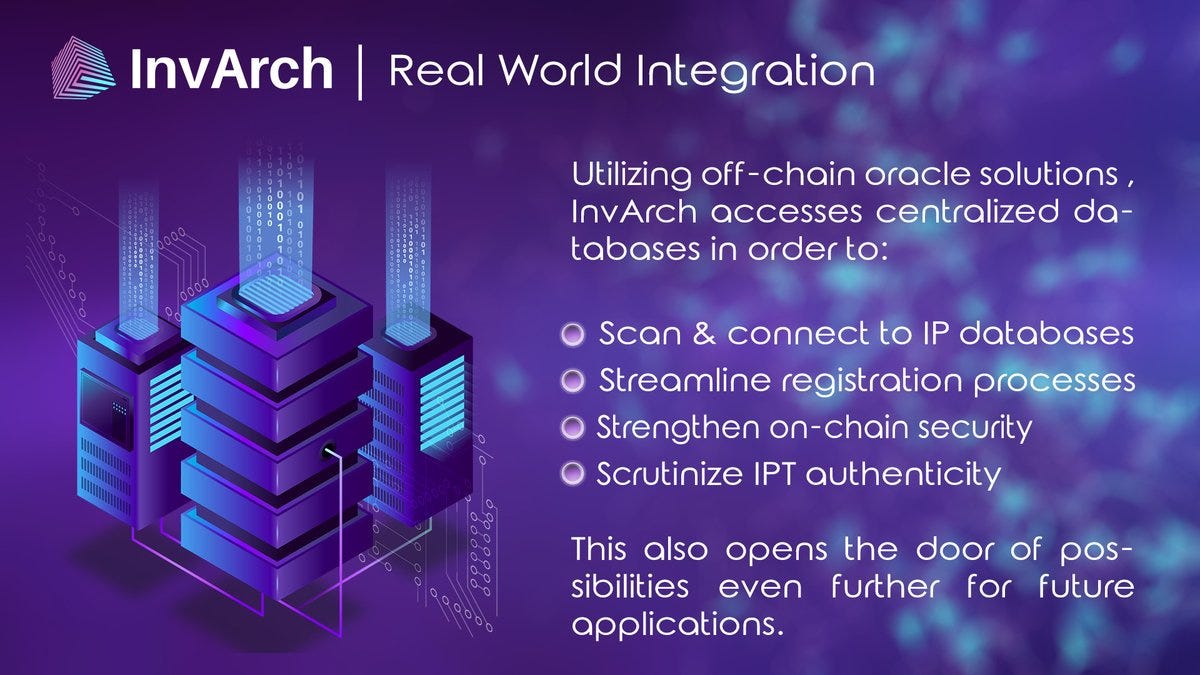
Firstly, it can be used for truly secure storage of your intellectual property, since when uploading information to the platform, all files are checked for uniqueness, if the file is noticed in copying, it will not be downloaded.
Also, this technology can really be used to find like-minded people who are ready to translate some idea into reality with you, the advantage is that your colleagues will not be able to count on large royalties, distributions from the product’s profits, since your agreement is recorded in a blockchain that cannot be hacked.
This can be used in many other areas, for example, each participant in the creation of a film / song can have a certain amount of IPT, and this will confirm his involvement in the creation of this product. Also, the InvArch Network can be used to create smart contracts that will benefit the creation and secure storage of IP (intellectual property).
$VARCH — utility token of the project

$VARCH — native token of the InvArch network. It is required for many important functions of the network, such as payment of commissions during operations, participation in online management, for the rally of IP Sets, the creation of decentralized companies.
In total, $1 billion VARCH tokens will be issued, which will be used to use all the functions and capabilities of the InvArch Network chain. Starting from the payment of commissions, ending with the creation of smart contracts. The token really has its own value and will be a prerequisite for using any of the capabilities of the InvArch Network.