Cetus Bridge powered by Wormhole and add liquidity to Cetus pools
WORMHOLE BRIDGE is a decentralized data transfer protocol that connects to multiple blockchains. Wormhole allows blockchains like Ethereum, Binance Smart Chain, Solana, Polygon, Avalanche, Aptos and more to interact with each other.
And it also solves two important problems that blockchains face.
- Tokens are difficult to move between blockchains without relying on centralized exchanges to connect and exchange tokens. However, this means that users are exposed to counterparty risk.
- Decentralized applications (DApps) and smart contracts on different blockchains cannot interact with each other, making cross-chain communication difficult.
- Now let's see how to use the Wormhole-based Cetus Bridge
. We go to the official website of Cetus ptotocol https://www.cetus.zone/
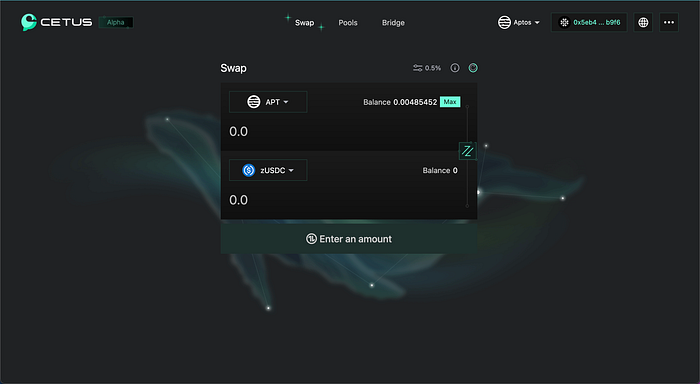
and go to the application page - https://app.cetus.zone/
What is concentrated liquidity?
Liquidity in conventional AMM is distributed evenly along the entire price curve (0, ∞). In comparison, concentrated liquidity is liquidity distributed within a certain price range. A concentrated liquidity protocol like Cetus allows liquidity providers to deposit their liquidity within their custom price ranges.
I chose the Ethereum and Aptos networks, we connect our metamask (you can use another wallet) in the Ethereum network. See which networks you can use (Aptos, Akala, Algorand, Aurora, Avalanche, Binance, Celo, Ethereum, Phantom, Karura, Klaytn, Moonbeam, Nir, Oasis, Polygon, Solana, Terra, Terra Classic, XPLA). Cetus provides the ability to use almost all popular networks.


Select the chain you wish to merge and connect a wallet supported by that chain, select the token you wish to transfer.
Now we connect the Aptos wallet and transfer tokens
After that, we confirm the transfer in the wallet and wait for confirmation
The confirmation took about 3 minutes, sometimes it can be longer.
1. What are the main benefits Cetus can bring to this ecosystem?
Capital efficiency is the first thing Cetus can redefine for this ecosystem based on the concentrated liquidity algorithm. Both liquidity providers and traders can benefit from this. By concentrating liquidity in an active price range, LPs can earn transaction fees more efficiently. Traders can enjoy trading with minimal slippage at the spot price during their swaps. In addition, developers can easily create their own products and use the most efficient source of liquidity Cetus by integrating it with open smart contracts and SDKs.
2. Considering that the user can set the end price range for a position, when the price of an asset fluctuates up and down during the period of market fluctuations, the price may go beyond the price range set for the position. In this case, the liquidity in that particular position will not be active and will stop earning commission until the price enters the position's price range again.
If the price of a trading pair increases or decreases in one direction, liquidity providers will receive more than one token in their positions, because this shows more demand for another token from swappers. When the price reaches the top or bottom of their positions, all of their liquidity will consist of only one asset.
When the price enters the range again, the liquidity in the position will become active and start earning commissions again. The liquidity composition for an active position will consist of two tokens instead of one type of asset.
LPs have very high flexibility in terms of concentrated liquidity. They can open as many liquidity positions with their price ranges as they want and need. The underlying concentrated liquidity algorithm establishes a mechanism that allows the real market to decide how to allocate liquidity, since most liquidity providers naturally concentrate their liquidity in the most active price ranges in line with market trends in order to earn more. operating costs.
My Discord: BaksTel#7716
My Twitter: https://twitter.com/NFTBaks