Как провести грамматический урок по модели TTT
На примере темы "There is/are" + еда и напитки
💡 Если вы преподаёте английский и хотите понять, как грамотно и уверенно планировать грамматические уроки, — этот материал для вас. Это не просто план — это мини-гайд, основанный на стандартах CELTA.
Вы можете использовать его как есть или адаптировать под своих студентов (главное — соблюдайте структуру).
AIMS:
Main: To present and practise “there is/are” with countable and uncountable nouns in the context of eating and drinking
Subsidiary: To provide students with speaking practice using TL in the context of describing the food in their fridge
T greets ss. T shows the picture of the table with different food. T elicits from students what meal it is. (Breakfast)


Test 1 (diagnostic) 5 min T-S, S, S-S-S, OC, T-S, S-T
- to test ss’ current understanding and identify gaps in vocabulary related to the topic of food
- to deal with MPF of vocabulary related to the topic of food – with emphasis on items ss did not know or were confused about
Clarifying problematic vocabulary
T asks ss to match words with the pictures. T tests ss’ knowledge of the words by asking them to put +,-,? next to each word.
Instructions: Work individually. Look at this box with food words, match the words with the pictures, write (+) if you know the word,(-) if you don’t ,(?) you are not sure. (T provides an example on the board) You have 1 minute.
Ss complete the task.
T asks ss if there are any (-) (?) ? If yes, ss mingle and find those who know the word and can help them. T monitors.
T asks one student to write answers on the board. T copes with problematic vocabulary, clarifying MPF, using pictures to convey meaning, and putting written record onto the board.
Test 2 (diagnostic) 5 min T-S, S-S, S-S/S-S, OC, T-S, S-T
Stage aims:
- to test ss’ current understanding and identify gaps in the difference between countable/uncountable nouns
T sets the second diagnostic test on countable and uncountable nouns. T writes on the board eggs and milk and elicits from ss whether they are countable or uncountable. T sets diagnostic task.
Instructions: Work in pairs. Put the words from ex.2 into two groups (count/uncount). You have 2 minutes.
T divides ss into two groups and asks them to stick countable and uncountable nouns onto the board. T focuses on some problematic words (toast, fruit, grapes, yoghurt) if there are some problems.
Teach through elicitation + MFP (guided discovery) 8 min T-S, S-T, S-S-S, OC, T-S, S-T
- to guide ss to fill in the gaps
- to concept check meaning of TL
- to raise ss’ awareness of the form of TL and its usage
T puts a gapped sentence onto the board and elicits from ss what is missing. (There__is_ a__ banana) T draws ss’ attention to the articles a/an (remind when to use what). T asks why they think so (Is banana countable? (Yes) Is it singular or plural? (singular)).
T adds two more sentences (There _are __five__oranges. There is some juice.)
T asks ss to work in groups of three and work out the rule independently by underlining the right option. T elicits right answers OC.
T encourages ss to pronounce the marker sentences and repeat them chorally, in pairs and individually. T focuses on stress and intonation in the sentence and also highlights some problematic points in pronunciation (the schwa sounds and linking).
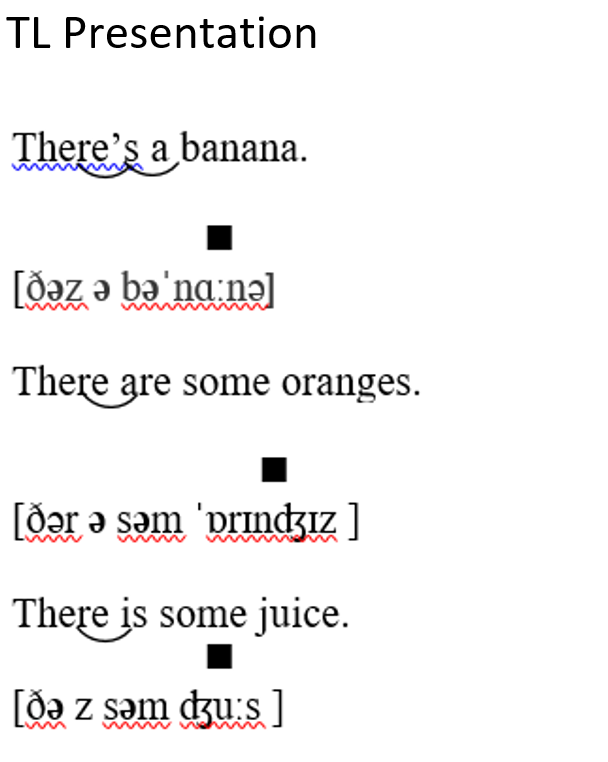
Substitution drill
T uses picture and sets up substitutional drill chorally and individually. Ss practise making sentences with different nouns.
Test 3 (Controlled practice) 8 min T-S, SSS-SSS, OC
T asks ss to complete the gap filling exercise. T organises a game activity. T uses grass skirts with gapped sentences and divide ss into teams. Ss complete the sentences with correct answer.
Instruction: Right now we are going to play the game. You work in groups of three, each of you gets this mini board where you write your answer. One person from your team goes and takes one sentence, you write correct answer on the board and show me. (Demonstrate!) If you are right, you get the point. ICQs: Do you take one sentence? (Yes) Do you go all together or one by one? (one by one) Do you write the answer on the board? (Yes)
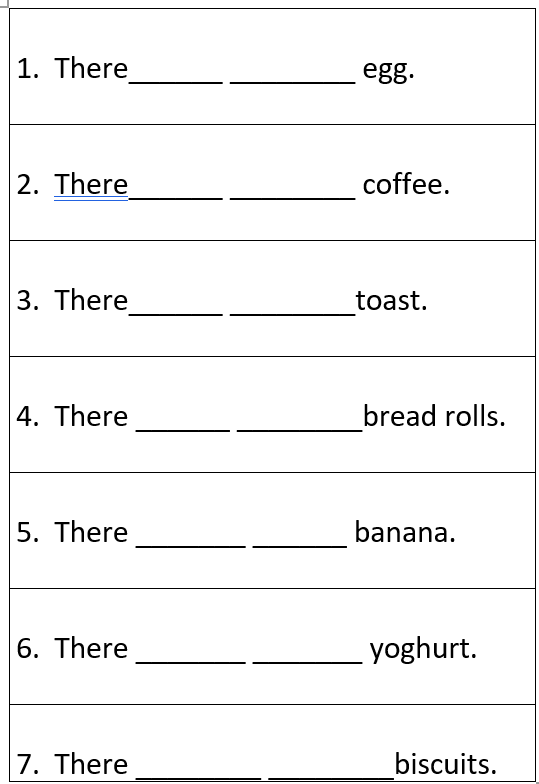
Semi-controlled practice 10 min T-S, S-T, S
- to provide ss with less controlled oral practice
- to consolidate understanding of the rule of using TL
T shows the picture of a full fridge. T sets the activity: This is my fridge. What can we see in my fridge? (T elicits answers from the students)
T gives students pictures of empty fridges and asks them to write what there is in their fridge. (T shows an example)

T sets the task. Instructions: Work in groups of three. Say to your groupmates what there is in your fridge. Listen to each other and decide who you’d like to go for dinner to and why. You have 5 minutes.
Ss discuss, T monitors and takes brief notes of ss’ successful and not successful use of TL.
Feedback on content and accuracy 3 min T-S, S-T, OC
- to praise ss and increase intrinsic motivation
- to improve accuracy
- to consolidate understanding of the rules of TL
T asks ss to share whose fridge they like and why. T draws ss attention to the board with some of ss’ mistakes. T encourages Ss to peer and self-correct these mistakes paying attention to the important moments and helping them if it’s necessary. Ss correct the mistakes.
⚡ Хотите больше таких инструментов и методических подсказок?
Подписывайтесь на мой Telegram-канал — там регулярно:
🔹 готовые планы и задания,
🔹 советы по методике,
🔹 честные разборы типичных ошибок преподавателей,
🔹 и поддержка для тех, кто хочет развиваться в профессии, но не хочет выгорать.