World's Indestructible Creature Is Now on the Moon
"Water bears", who are exclusively known for their ability to withstand extreme conditions, might have survived a crash on the Moon and are now stuck there.
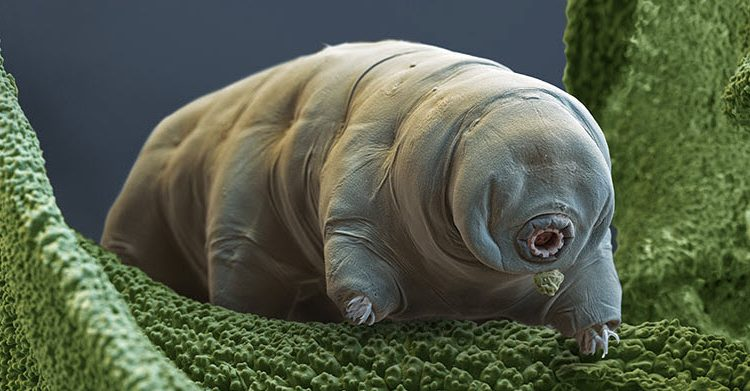
These eight-legged creatures are called tardigrades, but they are commonly known as water bears or moss piglets due to their chubby appearances. They are tiny, reaching 1 millimeter in length at maximum, but they have imposed one of the world’s biggest mysteries – why do they not die? Water bears can survive almost anything: being frozen to near absolute zero temperature (-272.8°C), conditions of zero oxygen, intense radiation, pressure as in Mariana trench, UV radiation and even the vacuum of space. This helped them survive five mass extinctions over the course of Earth’s history.
As their name suggests, they are mostly found in wet environment. However, due to their endurable strengths they are spread all around the globe: from Himalayas and volcanoes to deep oceans. And from 2019 we can presumably add the Earth’s natural satellite to this list.

Specifically, the Israeli spacecraft “Beresheet” was sent to the Moon in February 2019 and was the first ever non-governmental spacecraft to reach the surface of another celestial body. Its goal was to collect high-resolution images and probe the magnetic field. It also had a side-mission from Arch Mission Foundation – to store “a backup of planet Earth.” This includes an archive of 30 million pages: with thousands of classic books, almost the whole English Wikipedia, and the details of Copperfield’s magic tricks. Additionally, a sample of human DNA (hair and blood), samples from holy sites, and thousands of tardigrades in anhydrobiosis state. They were chosen due to their ability to survive for years without any food and for being able to be resurrected when put into water.
Anhydrobiosis (from Greek: "life without water") - a state of metabolism of a living organism as a response to conditions of extreme dryness. Aside from water bears, other examples include bakers' yeast and most of plant seeds.
Unfortunately, the landing of Beresheet failed and it crashed onto the surface of the Moon. The water bears, stuck on tape or preserved in amber, were scattered on the surface. Nova Spivack, the founder of Arch Mission Foundation, is certain that “the chances of survival for the tardigrades are extremely high.” But polluting other celestial bodies with living organisms concerns some scientists, who are worried about breaking the “pristine environment” of the Moon. However, since the mission was not targeted to understand the origin of life, it does not break any rules and is in agreement with NASA’s policies. Moreover, there is no chance that this event will lead to water bears building a civilization on the Moon, simply because they need water and air to come back to life.

Their secret to survival is simple: in extreme conditions they drop the metabolism rate to 0.01% of the usual, retract their limbs, curl up and cover themselves with a glass-like coating – thus entering a so called “tun” state. Tardigrades in this state were considered to be invincible; however, the latest study discovered that even they have an Achilles heel – high temperatures. Only a half of “tunned” tardigrades could survive after a day at 63°C, and this survival rate drops for higher temperatures and longer exposure times. So, if you are willing to wipe out all the water bears, you need to boil the oceans or wait for climate change to do it eventually. But you have to be quick — these death-cheating creatures are believed to adapt to slowly increasing temperatures in wildlife.
So next time you think about the trace of humanity in the Universe, along with Voyagers and Pioneers remember that we left indestructible moss piglets and 96 bags of feces produced by 6 Apollo missions on the Moon. Enjoy your day.