ZetaChain
ZetaChain is a novel L1 that has chain-agnostic interoperability built-in (EVM-compatible, Cosmos/IBC, Bitcoin, Dogecoin, Tron, etc.). Developers currently use ZetaChain’s messaging capabilities to send data and native value (without wrapping assets) between any chains. ZetaChain will also support native smart contracts, which let developers build omnichain dApps that orchestrate funds across chains from a single contract.
Who Are the Founders of ZetaChain?
ZetaChain’s founder was an early Coinbase employee and one of the creators of Basic Attention Token (BAT). Investors include all major market makers, top exchanges, early Coinbase and Binance employees including Dan Romero, Sam Rosenblum, and John Yi, as well as major contributors to some of the industry’s most widely adopted protocols and well known funds, including Polygon’s JD Kanani. Advisors to the project include Coinbase’s first Head of People Nathalie McGrath who scaled the industry leading exchange from 10 employees to over 800, and Juan Suarez, who served as in-house counsel at Coinbase from 2013 to 2022.
ZetaChain is a blockchain that connects everything. It enables interoperability between any blockchains or layers by providing cross-chain value transfer and message delivery, as well as native omnichain smart contract support. Applications built on ZetaChain — omnichain dApps (odApps) — can leverage liquidity and data on multiple networks and read and update state on all connected networks. ZetaChain’s native omnichain smart contract platform lets developers deploy contracts with the same ease as developing dApps for a single network like Ethereum, that orchestrate data and value across many or all chains. ZetaChain’s connectivity is chain-agnostic and can connect to and bring smart contract capabilities to even non-smart-contract chains like Bitcoin and Dogecoin.
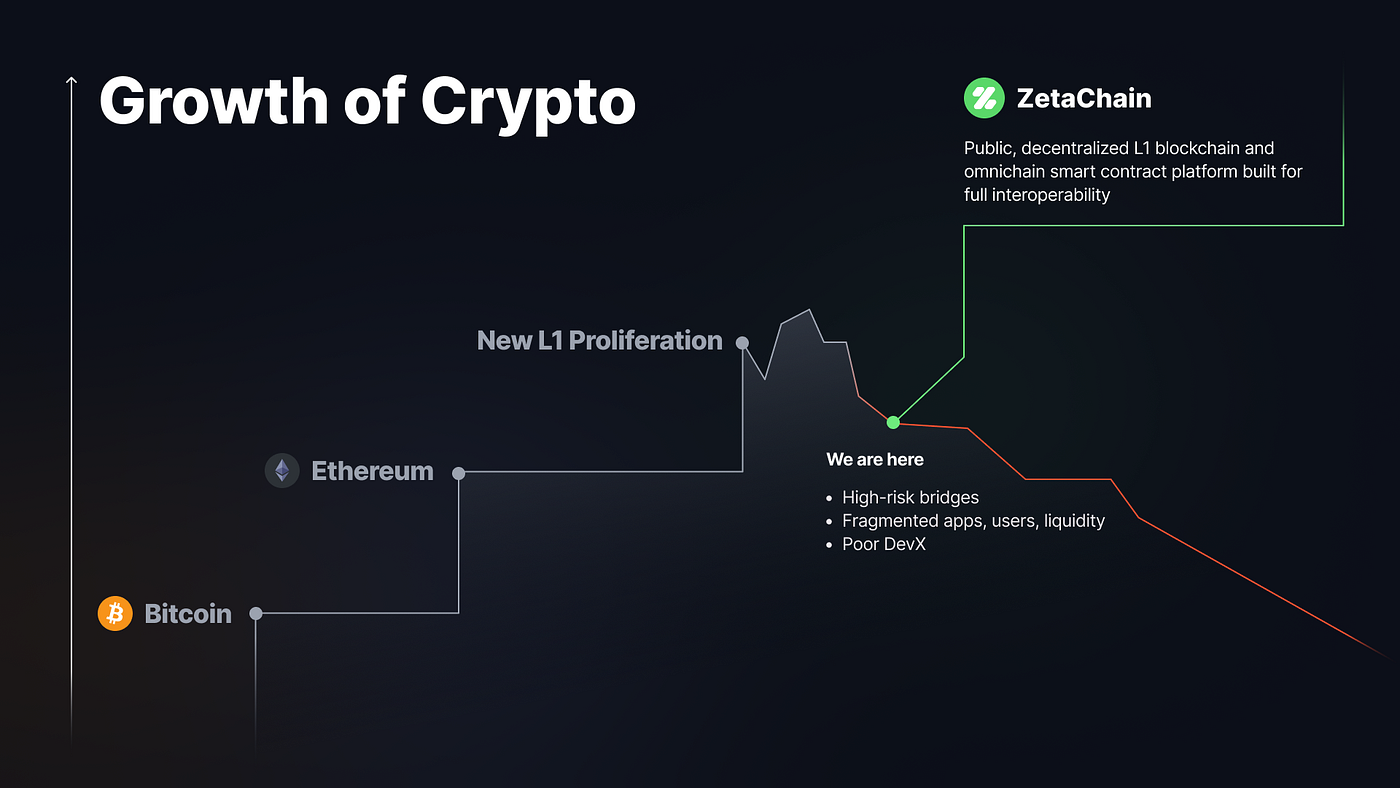
Approaches to interoperability seek to facilitate the exchange of assets and data between blockchains. The problem is that a preponderance of solutions involve questionable trust models and are not truly limitless in their inter-chain connectivity (check out our extensive analysis of the interoperability market to learn more). What seems underappreciated in the industry’s approach to interoperability is rethinking the dApp development toolkit itself. At ZetaChain, we’re building the first public L1 blockchain with built-in interoperability. That is, an open chain capable of supporting omnichain smart contracts that can access and manage assets and data on any other chain from a single point of logic. Our goal in this post is to shed more light on this innovative bottom-up approach within the evolving context of web3 interoperability. We also make specific comparisons to a couple of notable layer 1 blockchains and messaging protocols.
Five Progressions of Multichain Interoperability
Demand for greater blockchain interoperability is precipitated by the growth of multichain. Most approaches in the market for users are risky, fragmented from a UX and liquidity standpoint, restrictive in chain connectivity, and in general, really confusing. In this section, we review five key advancements in interoperability to the present.
New Layer 1s & Layer2s (closed systems)
In recent years since the advent of Ethereum, we’ve seen an influx of new Layer 1 blockchains and scaling solutions (L2s). Despite greater chain optionality — each with various tradeoffs — users are left with highly fragmented apps and ecosystems across which they are unable to easily navigate.
Centralized Exchanges
These organizations emerge to build around key layer 1 and 2 blockchains and behave like centralized bridges. For example, a user that acquires an asset on an L1 can transfer it to a centralized exchange wallet, trade it for a different asset that exists on a different chain within the centralized ledger, and then withdraw it into that new L1 system to use as he pleases. This method requires total trust in the centralized exchange entity and risks a single point of failure. What is actually happening inside the exchange is opaque to users.
Pairwise Bridges with Varying Security Models
These solutions allow users to transfer assets between different blockchains using wrapped assets i.e. an issued underlying representation of the real asset, typically locked away in a vault contract. Bridges and wrapped assets have varying or centralized trust models, which can put user assets at risk and lead to bridge/vault exploits, which unfortunately has been a frequent occurrence. They’re also limited in that, for example, the Polygon bridge only supports transfer of some assets to Polygon. Read this ZetaEducation tweet thread to learn more.
Cross-chain Bridge Aggregators
On top of pairwise bridges, we’ve seen builders develop aggregators such as LI.FI and Socket. These interfaces route users to the correct bridge based on the asset they desire to transfer so that a user doesn’t have to decide and understand each and every bridge. While this improves some of the UX, these solutions do not solve the underlying security variance and associated risk with bridges itself.
Cross-chain Messaging with Native Value Transfer
Another advancement in inter-blockchain connectivity is cross-chain messaging. New protocols like Axelar, Celer, and LayerZero offer generic cross-chain messaging that lets you send or relay a specific set of data between existing smart contracts on blockchains to achieve, in some cases, native value transfer. However, building more complex apps that require more than a few assets on chains — such as a stableswap DEX or lending — is harder to achieve. This method requires deploying a contract on every chain (so you can’t support non-smart chains like Bitcoin). It also involves more contract logic (and thus attack surface) and complexity of waiting for different messages to pass and synchronize state between separate chains. This translates to more risk and time in the user experience.
ZetaChain’s Approach to Blockchain Interoperability
The next standard for blockchain interoperability combines cross-chain messaging and the advent of native Omnichain Smart Contracts. While cross-chain messaging provides an asynchronous pattern of building and makes sense for some applications, Omnichain Smart Contracts provide a more synchronous way of building, as if everything were on one chain.
Together, these systems enable the creation of true omnichain dApps. Omnichain dApps span all chains by default and can access and manage assets and data on connected networks from a single point of logic. With this toolkit, developers have full creative ability to build complex, yet (to users) drastically simplified user experiences that leverage unified access to liquidity and data. In this paradigm, all wallets, networks, and assets can be abstracted away from the end user. Transactions happen in a single-step with no wrapping, and they immediately settle as if everything were on a single chain.
Today, ZetaChain is the only decentralized, public L1 blockchain that supports this complete toolkit for generic omnichain programmability. Developers can build using both synchronous (Omnichain Smart Contracts) and asynchronous (Cross-Chain Messaging) architectures, or a combination of both. ZetaChain is chain and layer agnostic, meaning ZetaChain can even enable Bitcoin smart contracts. This capability looks and feels much like Ethereum where a smart contract can be trusted to manage assets according to predetermined rules. The difference with ZetaChain is that a smart contract can do this for any data/asset on any blockchain. For a more in depth technical & security overview, check out this ZetaEducation thread.
Solution Comparison
In the following side-by-side feature comparison table, we share good examples of solutions to which ZetaChain can best be compared. Below the table, we categorize and describe how specific solutions approach interoperability in relation to ZetaChain. A key takeaway is that no public, decentralized solution exists today that has omnichain smart contract capabilities.
Discord: https://discord.gg/zetachain
Telegram: https://t.me/zetachainofficial