Staking vs. Bank Deposits in Europe
A Practical Guide to Yield, Risk, and Choosing Platforms
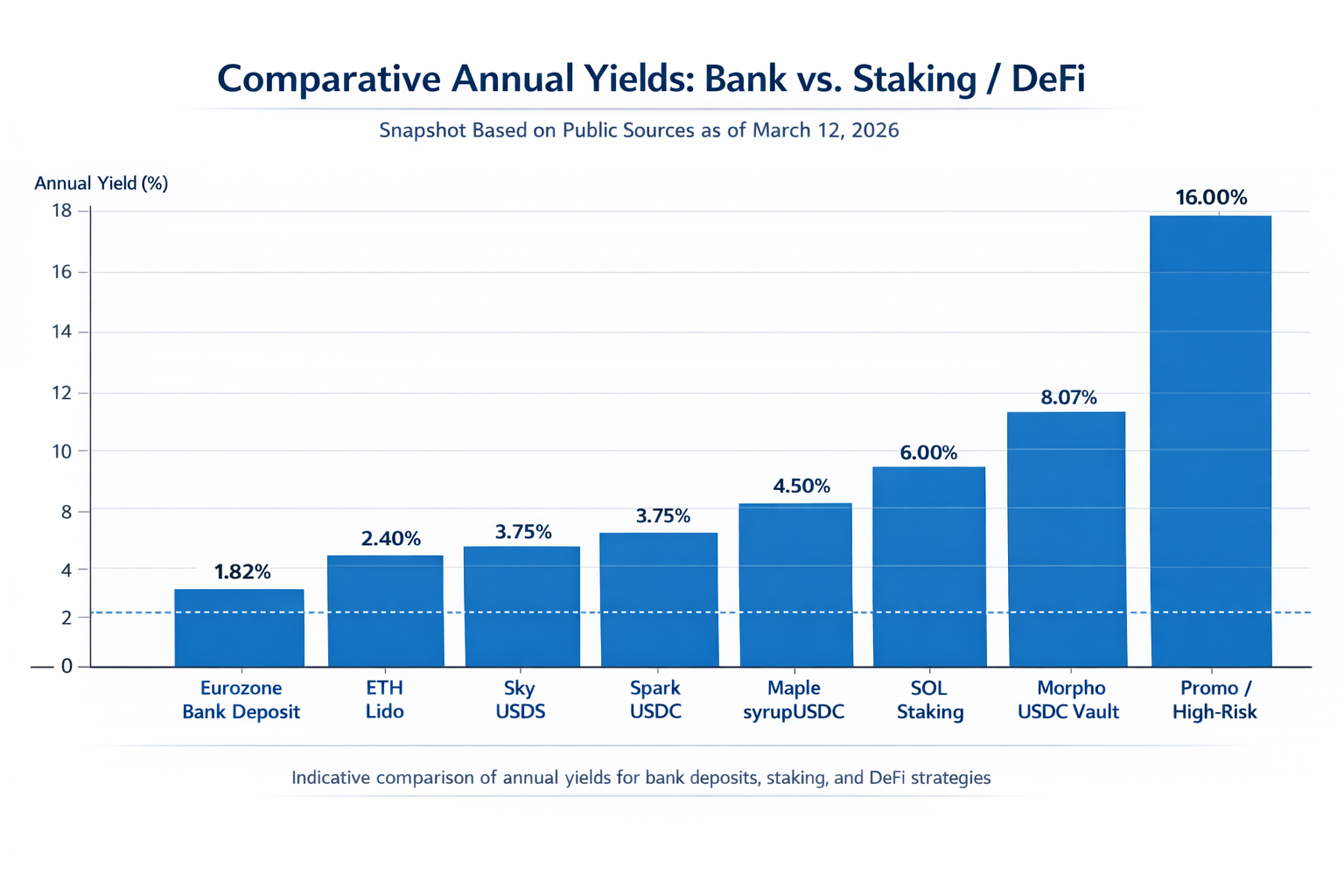
Brief conclusion: the average rate on new household deposits in the euro area in January 2026 was 1.82% annually, while typical on-chain and liquid staking solutions for major coins and stablecoins often show a range from 2.4% to 6%+, and high-yield strategies can go even higher — but with significantly greater risk. The market snapshot in the article is dated March 12, 2026. Yields in DeFi and staking are dynamic and can change quickly.
1. Why this topic has become especially relevant
In Europe, the classic bank deposit is increasingly seen not as a tool for growing capital, but as a way to temporarily park liquidity. According to the ECB, the average rate on new household deposits with an agreed maturity of up to one year in January 2026 was 1.82% per year, while overnight deposits yielded 0.25%. At the same time, euro area inflation in February 2026 was estimated at 1.9%, meaning the real return on the average deposit is now around zero.
Against this backdrop, staking and DeFi yield already look attractive simply from a mathematical standpoint: even a moderate 3.75–4.5% on stablecoins gives roughly 2–2.5 times more than the average term deposit in the euro area. But it is important not to confuse higher yield with higher safety.
A separate advantage of banks is regulatory protection. In the EU, deposits are guaranteed up to €100,000 per depositor per bank. Staking and DeFi do not have such a mechanism: instead, the user takes on market risk, smart contract risk, protocol risk, counterparty risk, and operational risk.

2. What exactly are we comparing: bank deposits, coin staking, stablecoin staking, and high-risk yield
- Bank deposit — low yield, but high legal protection and predictability.
- Coin staking — rewards for participating in the consensus of a proof-of-stake network. The main risk is the price of the coin itself.
- Stablecoin staking — in practice, this is usually not classical staking, but rather lending, a savings rate, a vault, or a liquidity strategy.
- High-risk staking / yield farming — strategies involving incentives, LP positions, long-tail collateral, leverage, non-standard liquidity, or promotional campaigns.

3. How much more staking can earn compared to a deposit

4. Best resources for analyzing and using staking / yield
Below is not just a list of platforms, but a practical combination of “where to find ideas” and “where to verify the actual conditions.”
4.1. For the initial screening of ideas
- DefiLlama — the best aggregator for a first look. It is useful for quickly understanding where yield currently sits by chain, token, TVL, and strategy category.
- ECB / Eurostat / European Commission — essential official sources for comparisons with deposits, inflation, and banking protection.
- The official websites of the protocols themselves — mandatory for the final verification of APY, jurisdictional restrictions, reward mechanics, and risks.
4.2. For coin staking
- ethereum.org — a core official overview of ETH staking options and the differences between solo, pooled, and liquid staking.
- Lido — the largest liquid staking provider for ETH; the front page showed around 2.4% APR.
- Solana staking docs / learn — a convenient official source on native SOL staking; Solana indicates a current benchmark of around 5–7% annually.
4.3. For stablecoins and moderate on-chain yield
- Aave — a liquid and straightforward lending protocol; the front page showed around 1.86% Supply APY for USDC.
- Sky — Sky Savings Rate for USDS; at the time of the snapshot — 3.75%.
- Spark — Savings v2 for USDC; the front page showed 3.75% APY.
- Maple / Syrup — institution-oriented stablecoin yield; syrupUSDC around 4.5%, syrupUSDT around 4.2%, weighted APY around 4.4%.
4.4. For high-risk and aggressive yield hunting
- Morpho vaults — allow users to find both moderate and more risky strategies for USDC and other assets. Examples on the front end showed net APY of 5.08%, 6.72%, and 8.07% depending on the curator and collateral set.
- Promotional campaigns and incentive-driven vaults — this is where 10–20%+ can sometimes appear, but more often it is not “pure market yield,” but rather base APY plus rewards, fee waivers, or token incentives.
5. Category No. 1 — coin staking
This is the most understandable option after a bank deposit. You keep exposure to the base asset and earn rewards for participating in the network. Here, profitability depends not only on APY, but also on the price of the coin. If the price of ETH or SOL falls, the real fiat return may be negative even when staking APY is positive.
- Lido for ETH: around 2.4% APR on the front page. The advantage is liquidity via stETH. The downsides are smart contract risk, derivative liquidity risk, and protocol risk.
- Solana native staking: current benchmark about 5–7% annually, with rewards paid every epoch. The advantage is that it is higher than a typical bank. The downside is that SOL volatility remains.
Who it suits: those who already want to hold the coin long term and do not plan to exit to fiat quickly.
6. Category No. 2 — stablecoin staking
Here, the term “staking” is conditional. In practice, the user usually provides liquidity to a lending protocol, deposits the asset into an on-chain savings model, or places it into a vault. The main idea is to generate yield without the price risk of a volatile coin itself. But the risk shifts toward the protocol, issuer, collateral, and smart contract.
Working market benchmarks at the time of the snapshot:
Who it suits: those who want to outperform a bank deposit, but do not want to hold a volatile coin. In practice, this is the most marketing-friendly category for content: 3.75–4.5% is already noticeably higher than European deposits, but still does not look implausible.

7. Category No. 3 — high-risk staking / yield
This is where numbers can start to look very attractive — 6%, 8%, 10%, 16% and higher — but behind this there is almost always an additional assumption.
- Long-tail collateral or non-standard vault markets.
- Rewards paid in the protocol’s own tokens instead of “clean” cash-like yield.
- Temporary promotions, fee waivers, and incentives.
- LP strategies, where in addition to APY there is also liquidity risk, volatility risk, and pool structure risk.
Examples worth mentioning honestly in the article:
- Morpho Hyperithm USDC vault — net APY 6.72% on the front end.
- Morpho Etherealm USDC vault — examples of market APY up to 8.07% in some markets.
- Maple Plasma syrupUSDT vault — around 16% expected APY, but the description explicitly states that this includes base yield, fee waivers, and additional rewards.
- Historical example: Syrup Season 1 — up to 38.3% total APY for early users, which clearly shows that ultra-high returns are often built on bonus mechanics, not on permanent market yield.
Who it suits: those who understand that they are buying risk, not “an improved version of a bank deposit.”
8. Mini-guide to DefiLlama: how to use it and how to search for pairs and assets
DefiLlama is convenient because it allows you to quickly filter out noise and create a first shortlist. According to the platform documentation, its yield search functions are built around the filters chain, token, sortBy, and limit. In the interface, this corresponds to a basic logic: choose a network, choose an asset, sort by APY or TVL, and open the pool details.
- Step 1. Open the Yields section. If you are looking specifically for stablecoins, it is better to go straight to Stablecoin Pools.
- Step 2. Select the token: for example USDC, USDT, ETH, or SOL.
- Step 3. Select the chain: Ethereum, Base, Arbitrum, Solana, etc.
- Step 4. First sort not by maximum APY, but by TVL. This reduces the chance of immediately ending up in small and aggressive pools.
- Step 5. Open the pool card and check: the project, TVL, APY, date, category, forecast, and whether incentives are present.
- Step 6. After making a shortlist, always go to the official website of the protocol and verify the numbers there.
What to look for in DefiLlama by category:
- For coin staking: ETH liquid staking, SOL staking, ETH liquid staking narrative, and then move to official providers.
- For stablecoins: Stablecoin Pools -> token = USDC / USDT / USDS -> sort by TVL -> compare Aave, Sky, Spark, Maple, and similar solutions.
- For high-risk: sort by APY, but manually verify reward emissions, incentives, and TVL size.

9. Example decision scenarios
Scenario A — a conservative European user.
Goal: beat a bank deposit without taking excessive risk.
Logic: bank 1.82% -> shortlist Sky / Spark / Maple 3.75–4.5% -> choose a platform with understandable mechanics and decent liquidity.
Scenario B — a user already holding ETH or SOL.
Goal: improve capital efficiency without selling the asset.
Logic: compare native staking, pooled staking, and liquid staking, then choose based on liquidity convenience and trust assumptions.
Scenario C — an aggressive APY hunter.
Goal: 8–15%+.
Logic: DefiLlama -> filter token USDC -> sort by APY -> select pools with acceptable TVL -> study incentives, collateral, fees, unlock conditions, and historical risks. This scenario already requires a portfolio approach and a limited position size.
10. Main risks that must not be omitted
- No €100,000 deposit guarantee, which is typical for EU bank deposits.
- Smart contract risk and protocol failure risk.
- Depeg risk for some stablecoins or derivative tokens.
- Provider risk, if a centralized service is used.
- Incentive risk: APY can drop sharply after a promotion ends or reward emissions stop.
- Market risk of the coin — especially important for ETH, SOL, and other volatile assets.
In 2025, ESMA separately warned consumers about the risks and limited protections associated with certain crypto-assets and providers. Therefore, in any educational material, it is better to make an honest distinction: a deposit is about capital protection, while staking is about higher yield at the cost of higher risk.
11. Final takeaway
The proper wording looks like this: Europeans are looking at staking and on-chain yield not because banks have disappeared, but because the average bank deposit yields too little to feel like capital growth. When a bank pays around 1.82% annually, while on-chain alternatives for major coins and stablecoins show 2.4–6%+, user attention naturally shifts toward staking and DeFi.
But the key professional thesis is not “staking is better than a bank,” but rather: “staking delivers higher yield because it shifts risk from the bank to the user.” That is exactly the formulation that makes the material strong, honest, and expert at the same time.
Sources and reference points
- ECB and ECB Data Portal: average rates on new household deposits in the euro area and by country (snapshot as of March 2026).
- Eurostat and the European Commission: euro area inflation at 1.9% and deposit guarantee rules up to €100,000.
- European Commission / ESMA: MiCA and warnings about risks and limited protection for crypto-assets.
- ethereum.org and Lido: ETH staking options, solo / pooled / liquid staking, front-page APR around 2.4%.
- Solana Learn / docs: native SOL staking, current benchmark around 5–7% annually.
- Aave, Sky, Spark, Maple, and Morpho: public APY front pages for USDC / USDS / syrupUSDC / syrupUSDT and examples of high-yield vaults.
- Maple insights: examples of incentive-driven strategies with double-digit yields and historical high-APY campaigns.
- DefiLlama Yields and docs.llama.fi: logic of chain, token, TVL, APY, and pool details filters.
This material is for informational purposes only and does not constitute investment advice.
Subscribe to the Telegram channel, where you’ll see more useful insights more often.
Office - Vana-Tartu mnt 79a, Peetri alevik, 75312 Rae vald, Harju maakond
Tel. +37254503075 / @angelskyee / Whatsup
Web. - Cryptotech.eu / Forminers.net
Crypto Exchange we recommend : 📈Bybit (https://www.bybit.com/ru-RU/invite/?ref=1YJ74O) | 🪙Cryptocom (https://crypto.com/app/sv5m9xhy95) | 📈MEXC (https://m.mexc.com/auth/signup?inviteCode=1UJTg) | 📈Gate (https://www.gate.io/signup/5822941) | 🔶Binance (https://accounts.binance.com/en/register?ref=28505757)
CoinEX - https://www.coinex.com/register?refer_code=cetqf
CRYPTO CARD in Telegram - https://karta.social/0700cd83b9