Skale network crash course: Ethereum + Skale. faster, cheaper and safer.
Nowadays, we’re talking about:
1. Ethereum blockchain with the 3 key factors of: Scalability, Costs, Security.
2. How Skale can help to make Ethereum faster, cheaper and safer.
1. Ethereum
Ethereum is a blockchain platform where developers can build blockchain applications without rebuild from scratch. The application developers and their users want to see a fast blockchain, small gas fee, high security.
Ethereum is not fast blockchain.
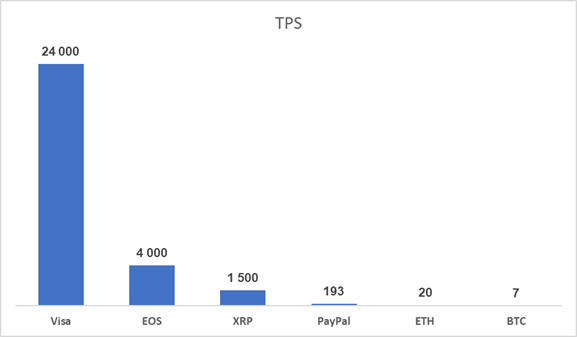
Ethereum blockchain has 20 TPS. Highest number of transactions (1,406,016) was on 17 of September 2020. Average is about 16.3 TPS. 9 of January 2021 speed of Ethereum is 15.2 TPS. Is it small or not? As an example, you can look at speed of another networks:
Ethereum gas price
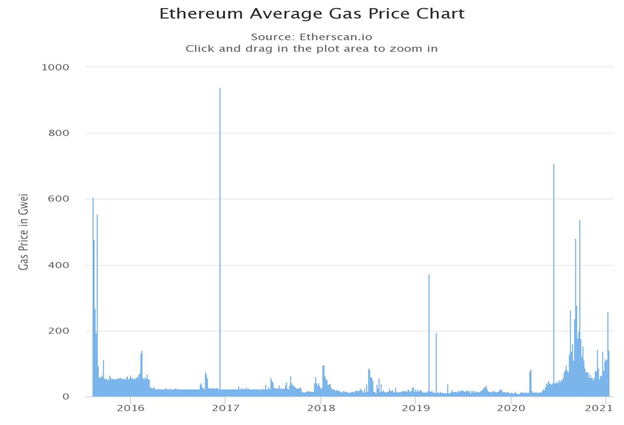
And what about transaction price. Sometimes payment for gas price is more than value of transaction. It’s strange economics. Look at historical Ethereum average gas price chart.
Ethereum security
Ethereum is a very protected network, but network isn’t isolated and interact with another services: exchanges, wallets… Its may be not so protected and it can make some issues of security.
So the questions for Ethereum is «How we can build a blockchain application in Ethereum platform as VISA or Stock Exchanges if it only have 20 TPS as well and payment per transaction may be more than its value? As how to expand it’s capabilities to meet requirement with most applications and make it safer?»
Example: Imagine a big city with 1 post office (named Ethereum) which has many options (payment, sendind/ receiving post…). It’s a very famous and popular post office. There are a few queues to the post office with different indicators speed and price: Low, Average, High. The post office handles every letters, parcels (transaction across the eth network) and has limitation – parcels per second (transaction per second - TPS). This is the most bottleneck to wrestle with.
What does it means for you? If you want to send message to your colleges in the organization (like users in applications on Ethereum blockchain), you need to go to this post office, stand in queue and price may be so high.
It’s logical to open small post office for one organization or district. This small post office will have:
- High speed and small (constant) price (may be 0) inside service zone
- Opportunity to quick connect to main post office
- Simple service (you don’t need to specials knowledge)
- High level of security.
Skale help to open such small offices.
2. How Skale can help to make Ethereum faster, cheaper and safer.
Skale - Thousands of Blockchains in One Network
SKALE is an elastic blockchain network that gives developers the ability to easily provision highly configurable fully decentralized chains that are instantly compatible with Ethereum.
Skale network has:
· High speed (2000 TPS)
· Small costs (Zero to Near-Zero Gas Fees)
· High level security (Random Node Selection/Frequent Node Rotation, Consensus via Asynchronous Binary Byzantine Agreement (ABBA)
More details: https://skale.network/whitepaper
https://skale.network/blog/technical-highlights/
High speed and small costs
SKALE offers dApps benefits that range from order of magnitude gains in transaction time, to order of magnitude drops in gas costs.
SKALE chains can execute sub-second block times, run up to 2 000 tps per node. But it’s only 1 node.
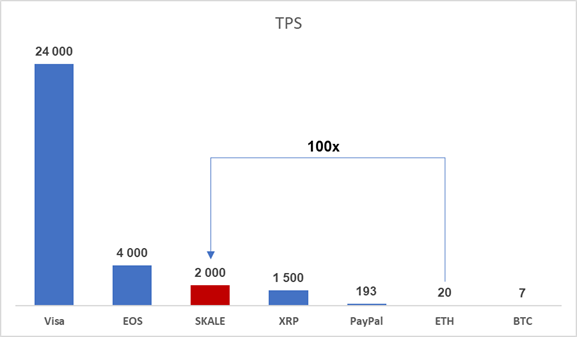
Skale achieved 20k TPS per 16 Node cluster at 2018 = 500k TPS with 400 nodes. Visa be afraid.
And what about gas fee? It’s Zero to Near-Zero.
Opportunity to quick connect to Ethereum
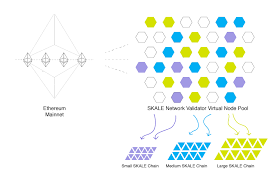
Each Elastic Sidechain allowing for interchain messaging. Virtualized subnodes on each chain are able to validate that a transaction was signed and committed by virtualized subnodes on another chain through the use of that chain’s group signature, which is made available to all other chains on the Ethereum mainnet.
Here is cool explainer video: https://www.youtube.com/watch?v=Twe_hPFGlbY
Here you can read about use cases:
https://skale.network/blog/use-cases-for-execution-layer-part-2-of-2/
Simple service
The SKALE Network is an open source project with many contributors. It’s very simple to use it. Skale eliminates unnecessary complexity so that you can speed up your dApps and smart contracts in no time with essentially no additional coding. Use your existing deployment script and just change 2 lines of code to deploy your solidity smart contracts to a configurable decentralized elastic sidechain.
More details: https://skale.network/docs/
High level of security
Safety is one of the important aspects of Skale technology. The SKALE network is built in such a way that each individual chain is constantly working on a system of nodes constantly rotating in a random order. The network is built using advanced cryptography technologies, including BLS threshold signatures and mathematically provable consunus.
Skale network and the code have passed the most stringent audit (ConsenSys Due Diligence and Quantstamp).
Skale network token ($SKL)
$SKL is a work and usage token. To have the right to work in the network, nodes must run the SKALE daemon and stake a predetermined amount of SKALE tokens on the Ethereum mainnet via a series of smart contracts known as the SKALE Manager.
$SKL based on the Ethereum mainnet. You can see $SKL details on etherscan (https://etherscan.io/token/0x00c83aecc790e8a4453e5dd3b0b4b3680501a7a7).
More details: https://skale.network/token/