Token Staking on the Super Platform
Complete Guide to Passive Income in DeFi.
Introduction
The cryptocurrency market has fully transitioned from the era of speculation to the era of yield generation. More users are now choosing long-term asset holding combined with passive income strategies.
The core instrument of this new financial model is staking.
The Super platform combines staking, liquidity solutions, multi-chain infrastructure, and instant liquidity within a single ecosystem.
This article is a complete guide covering:
- what staking is;
- how yield generation works;
- advantages of Super;
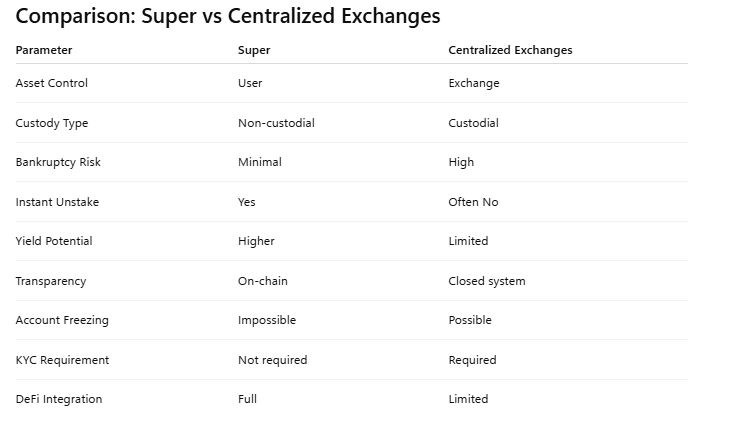
- comparison with centralized exchanges;
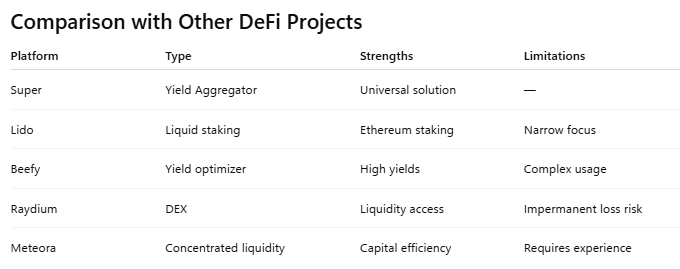
- comparison with other DeFi projects;
- risks involved;
- frequently asked questions.
What Is Staking
Staking is the process of locking cryptocurrency in a network operating under the Proof-of-Stake consensus mechanism, allowing users to support blockchain operations and earn rewards.
👉 your tokens generate income while remaining under your ownership.
Why Staking Became the Foundation of the Web3 Economy
The majority of modern blockchains now operate using Proof-of-Stake.
Investors no longer need constant trading activity — assets can work automatically.
Evolution of Staking
Self-Hosted Nodes
Centralized Exchange Staking
DeFi Aggregators
This is where Super introduces a new model — combining multiple yield sources without surrendering asset control.
What Is the Super Platform
Super is a multi-chain yield aggregation platform that enables users to earn rewards across multiple blockchain ecosystems through a single interface.
- staking;
- restaking;
- liquidity pools;
- yield strategies;
- instant withdrawals;
- asset management through Super Wallet.
Supported Networks
Super operates across multiple blockchain ecosystems:
- Ethereum
- Solana
- TON
- Sui
- Arbitrum
- Avalanche
- Celestia
- BNB Chain
- Polygon
- Optimism
- Base
- Tron
- Cosmos ecosystem
- Bitcoin wrapped assets
This enables diversified yield opportunities across different networks.
Key Advantages of Staking on Super
Non-Custodial Model
Users retain full ownership of their assets.
- private keys remain with the user;
- accounts cannot be frozen;
- no counterparty bankruptcy risk;
- independence from centralized operators.
Instant Unstake — Immediate Liquidity
Traditional staking often includes lock-up periods.
Super introduces a new standard:
Staking becomes comparable to regular asset holding.
Yield Aggregation
Users benefit from optimized returns without complex configuration.
Single-Asset Staking Without Impermanent Loss
Traditional liquidity pools require token pairs, exposing users to impermanent loss risk.
Super allows staking using a single asset, eliminating this issue.
Multi-Chain Yield Access
👉 Super functions as an infrastructure layer above DeFi protocols.
Where Yield Comes From
User rewards are generated from several sources:
- Blockchain rewards — payments distributed by networks for transaction validation participation.
- Validator commissions — a share of network transaction fees distributed to stakers.
- Liquidity incentives — additional rewards for providing liquidity to protocols.
- Protocol incentives — bonus rewards distributed by decentralized applications.
- DeFi strategy yields — profits generated through optimized decentralized finance strategies.
Yield rates are dynamic and depend on blockchain activity and market conditions.
Why Yields Are Higher Than on Exchanges
Staking Security
Infrastructure Security
- front-end protection;
- back-end protection;
- distributed denial-of-service protection;
- hardened server architecture;
- deep traffic inspection;
- secure network connections.
Architectural Security
Why Users Move Toward DeFi
- full asset ownership;
- elimination of intermediaries;
- transparency;
- global accessibility;
- higher yield opportunities.
The Future of Staking
Major industry trends include:
- liquid staking;
- restaking;
- cross-chain yield strategies;
- institutional staking adoption;
- DeFi evolving into global financial infrastructure.
Why Super Aligns With the Future of DeFi
- user asset control;
- instant liquidity;
- multi-chain infrastructure;
- automated yield optimization;
- simplified user experience.
FAQ — Frequently Asked Questions
What is staking?
Locking cryptocurrency to earn rewards.
Can funds be withdrawn anytime?
Yes, thanks to Instant Unstake.
Is yield fixed?
No, it depends on market conditions.
Can I start with a small amount?
Yes.
Is it beginner-friendly?
Yes, the interface is simplified.
Is staking passive income?
Yes.
Is it safer than exchanges?
Users maintain full control over their assets.
Conclusion
Staking has become the foundation of the new digital financial system.
- from trading to yield generation;
- from intermediaries to self-custody;
- from centralized platforms to decentralized financial ecosystems.
Super integrates the essential components of next-generation crypto finance:
- non-custodial asset ownership;
- aggregated yield opportunities;
- instant liquidity;
- multi-chain access;
- simplified participation.
Staking is no longer a complex tool reserved for experts — it is becoming a standard capital management strategy in the modern crypto economy.
Try Super platform: superearn.com