Does artificial intelligence threaten the labor market?
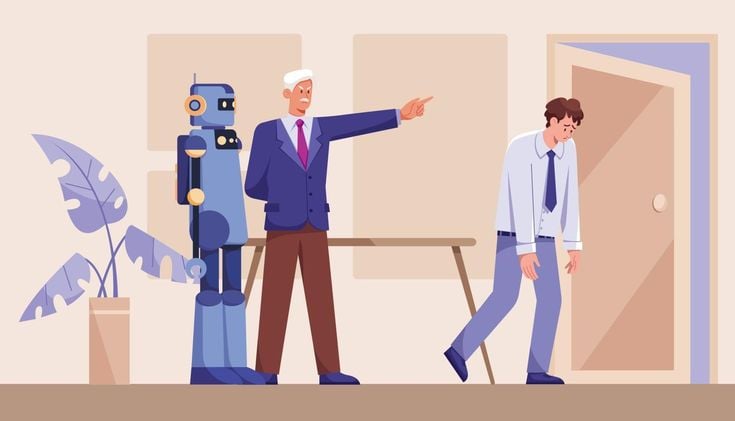
Over the past 50 years technology has been advancing at an unprecedented rate, fundamentally reshaping many industries. From the rise of personal computers in the 1970s to fully automated factories today, technological progress has never stopped and continues to this day. Since recently, the leading branch in this field is artificial intelligence or, as everybody knows it today, AI. Thanks to its rapid development, which has led to the widespread use by both the young and the old, artificial intelligence no longer seems to be a technology of the distant future. Moreover, AI has emerged as a revolutionary force for the job market, one that has completely transformed the nature of work and working environments across various industries. As artificial intelligence continues to evolve, its impact on employment is becoming complex and unclear, which raises the following question:
“Can AI fully replace the workforce?”
During the last few years, artificial intelligence has brought about significant changes on the labor market by redefining the way people work and the skills employers require. AI-powered systems are now now becoming increasingly common in multiple industries for automating repetitive tasks, analyzing large amounts of data and improving productivity. As the result of this trend, some traditional roles have declined in importance while some new fields related to AI, like data analysis, have been made more prominent. At the same time, employees are now expected to develop digital and analytical skills in order to remain competitive. Therefore, the relationship between artificial intelligence and the labor market has shifted greatly from simple automation towards a broader transformation of common working practices.

A research conducted by Anthropic reveals that AI hasn’t yet fulfilled its theoretical capability. Even though artificial intelligence was expected to be utilized by about 90% of the workforce in the IT and math sectors, it failed to reach even 40% of it. In fact, use of AI hasn’t been observed at all in several fields: production, agriculture, construction, healthcare support and others. This research suggests, that analysts often overestimate AI’s ability to replace human workers.
However, there still is a considerable risk that robots will replace humans who are primarily tasked with repetitive jobs. That doesn’t mean corporations are not going to hire anyone new, but they predict that they will need fewer humans in general, and that is mostly going to land on the youngest staff, since they are often the ones doing those repetitious jobs. Hence, number of work positions for younger generation may decline dramatically and starting a new career would be more challenging.
"As we roll out more Generative AI and agents, it should change the way our work is done. We will need fewer people doing some of the jobs that are being done today, and more people doing other types of jobs. It’s hard to know exactly where this nets out over time, but in the next few years, we expect that this will reduce our total corporate workforce as we get efficiency gains from using AI extensively across the company." — Andy Jassy, CEO of Amazon
In spite of all challenges, artificial intelligence is expected to create more new working positions than it is expected to take away. According to the World Economic
Forum, AI and automation are predicted to contribute 69 million new jobs worldwide by 2028. In addition, a study by Nielsen reports remarkable 66% increase in employee productivity through implementation of AI. By automating routine and repetitive tasks, AI frees up time for workers to focus on more complex, creative and innovative activities. This means that the enhanced productivity and development driven by AI have a potential to stimulate economic growth. Well-known consulting company McKinsey estimated that AI could contribute up to 13 trillion dollars to the global economy by 2030.
Research led by International Economic Development Council (IEDC) concludes that corporations that actively integrate AI into their operations while at the same time investing in human capital development will be better prepared for long-term deficit of skilled professionals on the rapidly changing labor market. Much like past technological revolutions, the rise of artificial intelligence presents both challenges and opportunities for many global industries. History has shown that while these shifts often lead to initial controversies and struggles, they ultimately create completely new fields, redefine employees' roles and boost economic growth. Furthermore, AI has a potential to cause unseen innovation and progress.