The Inefficient Market Hypothesis
Introduction
Where are all the consumer apps? Over the past few years, crypto has exhausted the speculative appetite for DeFi, NFTs, memecoins, and L2s, and failed to materially impact society. We have better, faster, stronger blockchain infrastructure, but no consumer apps to show for it. It is easy to look at a stagnant crypto industry and forget how far the space has come, how broken legacy markets are, and how big the opportunity is.
In this report, we will take a practical look at some of the most inefficient markets that exist today and draw parallels to crypto apps exploring solutions. We will unpack zkTLS and discuss why it is a major breakthrough for crypto consumer apps.
Precedence in Legacy and Crypto
There are numerous examples of inefficient markets in TradFi being exploited for progress.
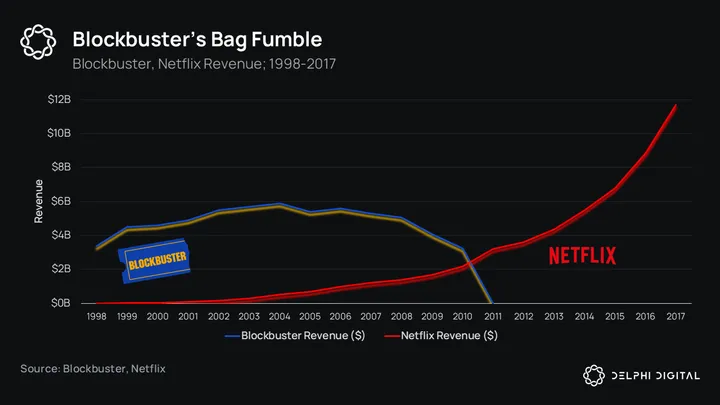
Blockbuster → Redbox → Netflix
Blockbuster reached its peak revenue of $6B in 2004. It was still generating $4B in 2009 before a rapid decline into bankruptcy in 2010. Blockbuster declined to purchase Netflix for $50M in 2000, showing a dedication to brick-and-mortar stores for media content on the cusp of the internet age. This unwillingness to adapt resulted in a rapid downfall.
Farming can be an extremely difficult industry to navigate without financial derivatives. Forward contracts for timber and agriculture can help immensely. They allow farmers to plan ahead, lock in prices for a future harvest, and secure financing.
Even within crypto, there is a concrete track record of inefficient markets being created and subsequently exploited. While crypto’s proclivity to create inefficiencies is ironic, it is encouraging how quickly solutions emerge to undermine them.
We have extensively documented the broken ve-model, and similar projects like Radiant Capital.
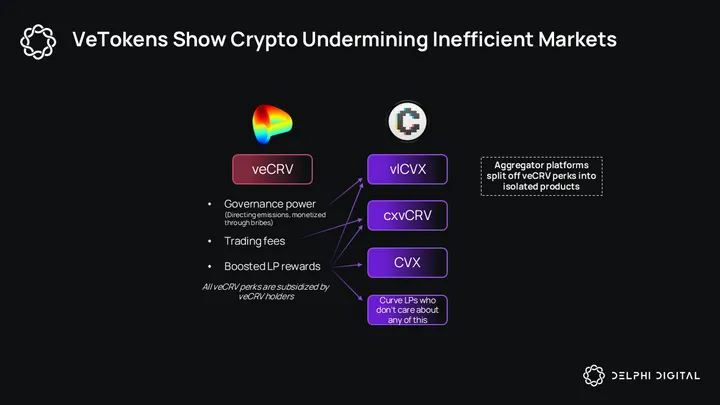
Aggregators assume the liquidity burden and split off veToken perks into isolated products. Farming optimizers such as Beefy Finance programmatically dump veToken emissions, distributing them as yield to platform users. The end result is an a la carte menu for veToken perks, rendering the locking mechanism powerless, while those who do lock lose money.
While it is often prudent for projects to use deposit caps and soft rollouts for safety, they ignore market forces. Real estate in oversubscribed venues (Ribbon, Eigenlayer, Aave) should be commercialized. There is an innate dollar value attached to space in the oversubscribed vault. Users who give up their spot should be able to sell it to the highest bidder.
Since Uniswap’s canonical airdrop in 2020, airdrop sybil farmers have extracted immense amounts of value from subsequent tokens. This year, the pendulum has swung in the opposite direction, as projects farm users with vague and noncommittal points programs. Apps like Pendle have found product market fit by allowing users to speculate on the points market.
The picture of the free market is necessarily one of harmony and mutual benefit. Every inefficient and restricted market that exists today is an opportunity for crypto to infiltrate and improve society.
Gig Economy – Ride Sharing
The taxi model is extremely inefficient – rife with counterparty risk, friction, driver downtime, and unreliability. The model only works well in major cities.
Uber turned the taxi model on its head. Uber assimilated the concept of a taxi into everyday life, offering flexibility, convenience, and cost reduction for both riders and drivers. The regulatory and social controversy surrounding Uber’s rise was a testament to how disruptive the idea was.
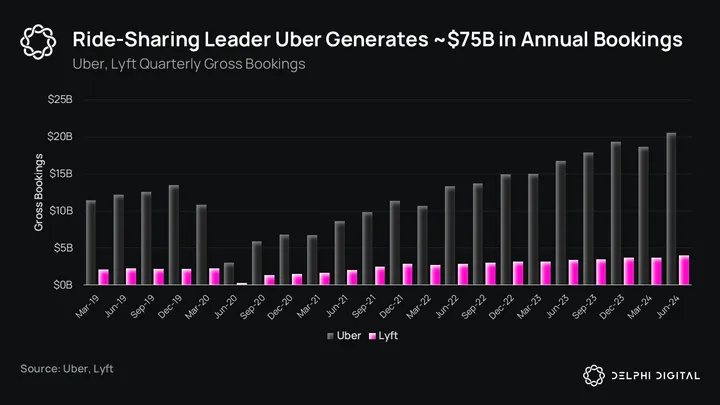
The global ride-sharing and taxi market is estimated at ~$271B in 2024. Uber’s $75B annual gross bookings support this estimate.
Despite the industry’s rise, Uber and other Web2 ride-sharing companies are just as vulnerable as the taxi industry was. The Uber model is a good idea with poor execution. Web2 ride-hailing, like Redbox, is the middle child of innovation.
Uber and Lyft treat drivers very poorly, taking 45-50% of fares. Reported revenue as a percentage of gross bookings suggests 30%, but this is a result of shady accounting tactics such as external fees.
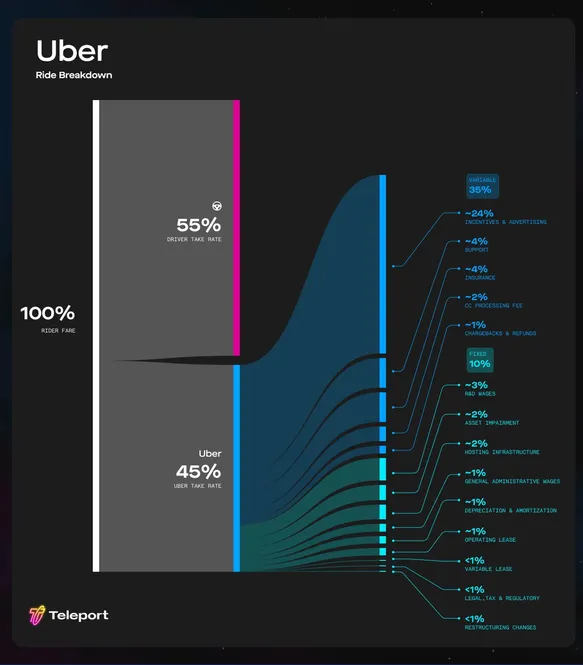
The 45% gross take rate goes to sustain a gluttonous, dysfunctional business that struggled mightily to make a profit. The majority of the value extracted by Uber (53% of Uber’s share, 24% of fare) goes to incentives and marketing. There are two major issues with this:
- Advertisements are unnecessary. Ride-hailing is a sticky business with established leaders who enjoy strong moats. The taxi industry never ran ads, nor did the horse carriage industry. These services exist and generate usage because people need them. Outside of the early S-curve adoption period, advertising for ride-sharing offers limited upside. Lowering costs for users and increasing wages for drivers would be a far more effective method to gain market share.
- It is unethical. Uber is simply connecting buyers and sellers of transportation. Outside of insurance, dispute resolution, reputation, price discovery, etc., it has very little responsibility. There is a strong case that Uber should be a public good. At the very least, the value Uber extracts should satisfy its fiduciary duty to shareholders and maximize value. But Uber’s marketing is its biggest variable expense cutting into potential profit. During the peak of Covid-19, when rid-sharing was at a historic low, Uber ran an expansive “No mask, no ride” ad campaign. The ROI of this ad campaign for stakeholders remains unclear. Uber’s wastefulness negatively affects drivers, riders, and shareholders.
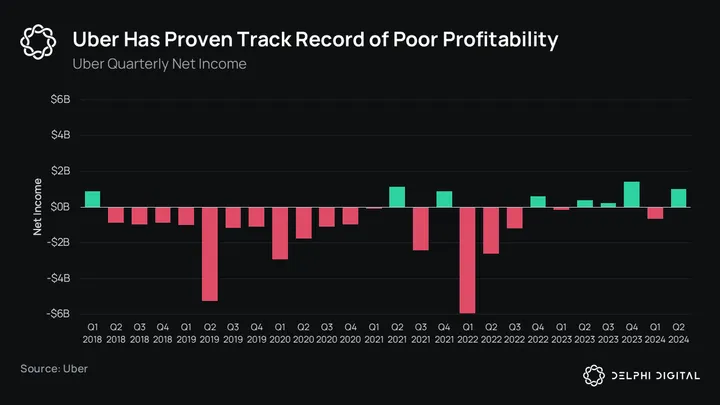
After several years of poor earnings, Uber has strung together several profitable quarters. Interestingly, this coincides with a drop in reported revenue as a % of gross bookings and growing public awareness of algorithmic wage discrimination. Uber appears to offer drivers different prices for the same rides, even after controlling for confounding variables. There is a gray area around the legality of this practice. Uber drivers are legally classified as contractors but do not have pricing power. Even with algorithmic wage discrimination and misleading reporting practices, Uber is barely profitable.
Teleport
Teleport replaces bloated Web2 intermediaries with a decentralized marketplace called the TRIP ride-share protocol. TRIP is built on Solana and is available on the iOS app store.
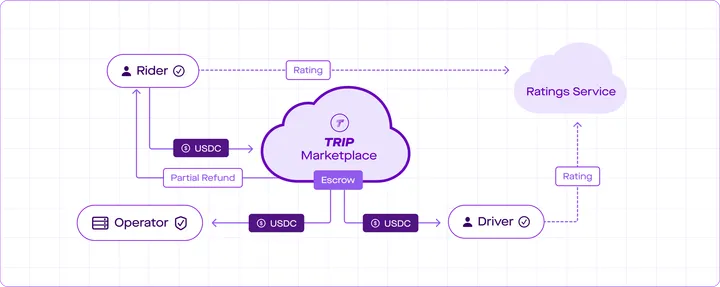
Teleport guts the legacy structure for a minimalist model with few entities:
- Drivers and riders
- Operators – handle the regulatory and operational requirements of providing rideshare service.
- TRIP marketplace – DAO-governed smart contracts that offer coordination and consensus services to the network. Help the network remain neutral and fair without relying on centralized authority.
- Ambassadors – help the TRIP Marketplace overcome supply/demand imbalances by recruiting additional drivers and riders.
- Verifiers – onboarding facilitators. Inspect driver licenses, perform car inspections, conduct background checks and verify phone numbers.
- Auditors – confirming legal and operational eligibility of verifiers and operators
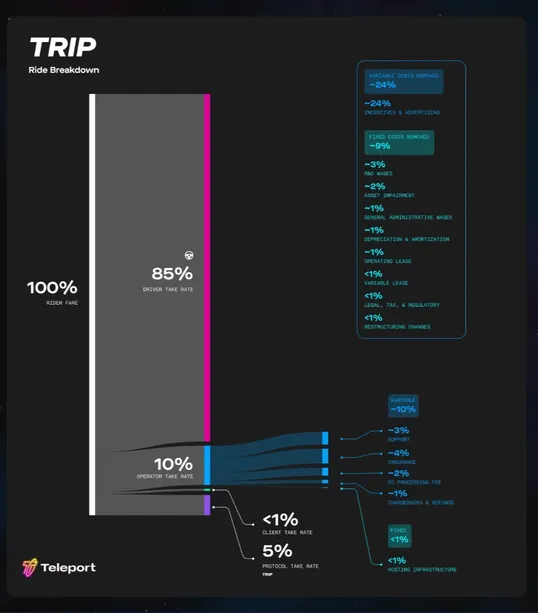
Teleport eliminates advertising and unnecessary fixed costs such as R&D wages. The TRIP protocol passes on cost savings to drivers and riders and incentivizes them to recruit new users. A complete analysis of cost structure differences can be found in Teleport’s Ridesharing Econ 101.
TRIP Miles are points allocated to network participants in accordance to their contributions to the network. They can be redeemed for TRIP rewards, which are represented as NFTs on Solana. The NFTs are classified into 41 tiers, with higher tiers often possessing unique attributes. The NFTs are meant to represent one’s contribution to the network. When Teleport releases a token, there could be some interesting dynamics between TRIP miles, NFTs, and revenue share.
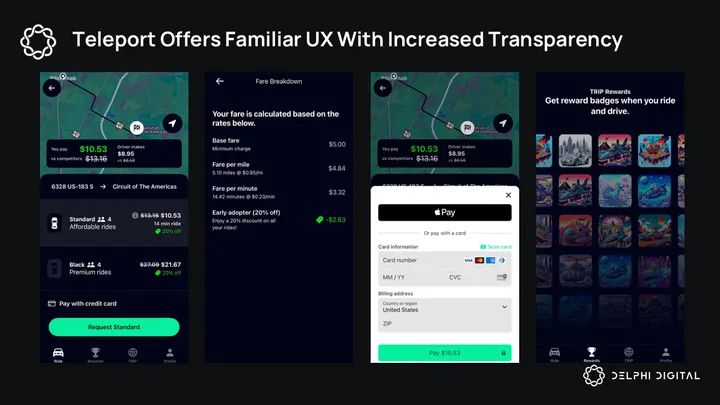
Compared to Uber and Lyft, Teleport is a major improvement for drivers:
- Paid better – 85% driver take rate vs ~55% on incumbent marketplaces.
- Paid instantly – Drivers can opt-in to be paid instantly with USDC. Uber and Lyft have a payment delay unless certain criteria are met, and follow a traditional paycheck structure.
- Fare transparency – On the quote screen, Teleport explains what a user pays compared to the estimated rate on Web2 marketplaces, as well as the difference in earnings for the driver.
Teleport is currently live in Austin, TX, and plans to expand to all of Texas soon. After early traction, usage has stalled. Teleport had strong driver demand and positive feedback, but unanticipated system issues prevented sustained growth. A new version will be released soon that should provide a smoother experience and a greater capacity to scale. Read more about Teleport on our Alpha Feed.
Gig Economy – Food Delivery
Food delivery, like ride-sharing, is ripe for disruption due to the unsustainable nature of Web2 solutions. But the situation is far more nuanced, and will require a more intricate solution.
Ride-hailing is matching riders with drivers – a relatively simple business. Food delivery is essentially offering an Uber ride to the food orderer for a fraction of the cost – a $2-3 delivery fee. This is a logistical conundrum. Somehow, an Uber/taxi ride that costs $15 dollars needs to cost $3 for food delivery. It also requires more work for the driver due to food pick-up and drop-off.
In the past, Pizza shops hired in-house delivery drivers. This business model was most popular for pizza, as pizza is a popular delivery item and the expense overhead is easily justified.
Food delivery companies like DoorDash, Grubhub, and Uber Eats emerged with similar models – they pay drivers with delivery fees and a commission charged on the food order. In this sense, Uber Eats and DoorDash are delivery contractors that allow restaurants to avoid the commitment and overhead of in-house delivery drivers.

The global food delivery market has ballooned to an estimated $350B. DoorDash and Uber Eats are on pace for $140B in annual gross bookings combined. DoorDash has a partnership with 80% of US restaurants.
DoorDash offers a tier-based plan for restaurants:
Tiers are differentiated by inclusion in marketing and Dash Pass, DoorDash’s user-facing subscription plan. Major franchises like McDonalds are offered special exclusivity deals at lower rates, which are subsidized by other businesses.

DoorDash spends in excess of 20% of its revenue on incentives and marketing, resulting in similar issues exhibited by the ridesharing industry. 20-30% commissions are insurmountable for restaurants that already operate at razor-thin margins.
Nosh Delivery
Nosh Delivery is a Web3 food delivery company that began several years ago as a restaurant-owned co-op in Colorado. Nosh has been highly successful, servicing 302 restaurants and generating $8M 2022 GMV.

Nosh Delivery is a positive-sum business that charges 1/3 of DoorDash’s average take rate. Restaurants own the network, receive dividends according to their contribution, and benefit from growth as more drivers and users are onboarded.
There is no marketing budget; restaurants market to nearby restaurants and grow the business through word of mouth. A strong local presence makes exclusivity deals more attainable, a privilege typically reserved for DoorDash and other major players. Nosh has an exclusivity deal with 40% of its partnered restaurants.
The local co-op model ends up a lot like in-house delivery – participating restaurants share both the costs and wealth generated by the delivery network. Co-ops have been popping up popping everywhere, necessitated by unfavorable terms offered by legacy marketplaces. Collectively, local co-ops command ~$500M in the US out of the $350B global market.
Local delivery co-ops are profitable businesses with an irresistible value proposition for restaurants, making them highly competitive at the local level. The model is difficult to scale due to its hyper-localized network effects.
Nosh recently released the whitepaper for Local Protocol, its crypto-economic and networking infrastructure for decentralized marketplaces. Local Protocol will allow Nosh Delivery to scale the benefits of locally owned networks by building shared infrastructure.
- Permissionless onboarding
- Cryptographically verified transactions at scale
- Programmatic distribution of ownership and incentives via the transaction graph
- Dispute resolution protocol
- Extensibility

The transaction graph is a bipartite graph of buyer-producer economic relationships that ascertains user’s graph value. Graph value measures a user’s contribution to the network for purposes of incentive distribution. Graph value is made up of 4 components:
- Edge weights – cumulative fees between a pair of nodes
- Eigenvector centrality – measures a node’s influence based on its proximity to and relationships with other valuable nodes.
- Reputation – peer evaluation score by real users who share an interaction, similar to Uber and Lyft.
- Objective data within the graph
This approach is a stark contrast to standard crypto incentive distribution, often relying on surface-level metrics like TVL or transaction volume. Nosh’s transaction graph approach is a more dynamic, self-optimizing solution. It solves many of the problems facing DePIN projects like Helium, who are trying to bootstrap decentralized hardware networks.
Loyalty Programs
Loyalty programs are a very popular tool across most retail sectors to improve customer retention. They have shown to be effective, but they are highly inefficient from a microeconomic perspective.
The best example of this is fast food loyalty programs. Users will typically earn points when buying through a rewards app or scanning at checkout. These points are redeemable for menu items at an arbitrary new pricing catalog.

This uncorrelated secret menu of loyalty conversion is prevalent throughout the fast food industry. Four of the most successful franchises – Wendy’s, Chipotle, McDonald’s, and Chick-fil-A, have a high degree of variability in the implied value of loyalty points across menu items. Savvy users can often generate savings of over 10%, while oblivious users may earn below 5%.

- Wendy’s, Chipotle, McDonald’s, and Chick-fil-A have a combined annual revenue of over $50B. Given the 10% potential upside for optimal loyalty program participation, there is a $5B optimization opportunity from these four franchises alone. Of course, this assumes 100% program participation and disregards price discrepancies and other factors. The global loyalty program market was estimated at $215B in 2020. These inefficient markets were likely created to allow professional coupon-ers and customers in need to extract additional value, while clawing back customer retention costs from less sensitive users. Nonetheless, this grossly inefficient market is low-hanging fruit for disruption. There are additional points of friction in the loyalty program process worth addressing:There is a massive opportunity to abstract away these nuisances from the user, removing the link between the user and the loyalty program altogether.Create an app that registers for all existing loyalty programs simultaneously. This can be done proactively (the app seeds its own accounts) and on a user’s behalf upon signup.When visiting fast food chains, users have two options:At the point of purchase, the app feeds the user the QR code corresponding with the account necessary for optimal points accrual/redemption. On the backend, the app is aggregating points earned from all users and all programs, redeeming them in the most advantageous way, and bringing the reward forward in time for an instant feedback loop. The system would work like 1inch + Tornado Cash for loyalty program accounts.Users have a way to passively gamble on a free meal at no cost to themselves, or earn a more practical and optimal loyalty reward as a discount on their spending in the moment. And only deal with one app, not multiple.Once this app picks up steam, it would likely meet retaliation from restaurants, as it creates a disconnect between the user and the program. Incumbent programs could implement rate limiting or geographic restrictions on loyalty rewards. This could strain the ability of the app to meet demand, but would ultimately just require a more complex mechanism design.Blackbird.xyzBlackbird is tokenizing loyalty programs with its loyalty-based application for restaurants built on Base. Restaurants that opt-in to Blackbird are onboarded to the Blackbird app and become discoverable by Blackbird users. Users visit restaurants and check-in, earning FLY rewards.Flynet is L3 on Base with two native tokens:
- Sign up – registering for loyalty programs – fast food franchises, grocery stores, local sandwich shops, brick & mortar brands (Khol’s Cash, Sephora)- is a cumbersome process, one that is unlikely to pay off unless customers are diligent. Managing numerous different reward apps is a nuisance as well.
- Time delay – In most loyalty programs, customers accrue points over multiple visits, eventually earning a reward. This dynamic distances/separates the reward from the behavior.
- FLY – Blackbird’s native loyalty token/reward currency, available for use exclusively within the Blackbird app and pegged to 1c. FLY is used to purchase goods and services from Blackbird restaurants. FLY is currently earned through completing activities at restaurants, with the majority of emissions stemming from “check-ins.” It can also be purchased/minted through the app at 1c.
- F2 – Blackbird’s native gas token with developing utility. Importantly, usage of the Blackbird app will not require users to navigate the blockchain aspect. It will take place on the back end and be subsidized by Blackbird entities. There is ample room for future utility for F2, especially as the value of the Blackbird data set increases with network growth.
Legacy programs lock points, have arbitrary strings attached, are not transferrable across restaurants, and have highly variable rules. FLY represents an evolution in loyalty programs offering several unique features:
- VIP offerings – FLY can be redeemed for free food or discounts or used as payment for exclusive events. Premium offerings can be gated behind a minimum FLY balance.
- FLY can be used to settle tabs at participating restaurants, allowing users to bypass the traditional checkout process.
- Blackbird’s model offers valuable data insights. The value of a customer is a function of their FLY throughput and is displayed on their profile like a reputation score. FLY can be used to incentivize users to share information about themselves.

FLY can be earned by contributing to the restaurant economy via check-ins or payments. It can be minted by users at a fixed exchange rate, and is an important tool for incentive alignment with a broad potential design space.
Blackbird is an interesting initiative to rethink loyalty programs. It is gaining traction in New York, Charleston, and Atlanta. The adoption shows the willingness of restaurants to try new incentive methods and an admission that current systems have room for improvement. Blackbird doesn’t directly undermine the inefficiencies outlined earlier, but is an example of an alternate approach that could emerge once legacy programs are exploited. Read more about Blackbird in our Alpha Feed or in the Flypaper.
Gift Cards
Gift cards are an interesting case study. They are a consumer-originated market inefficiency, borne out of societal taboos around gift-giving etiquette.
The global gift card market is estimated to be between $320B – $984B. Unused gift cards are estimated at $21B – $30B. Realistically, the market for gift card solutions extends far beyond wasted gift cards; it encompasses the total value of all gift cards issued. Even if a gift card is not wasted, people generally aren’t thrilled to use them. The cardholder must keep the card on hand for some time and/or alter their ordinary behavior to redeem it. The typical gift card recipient would prefer cash.

Gift cards are a fantastic arrangement for major issuers like Starbucks. In 2023, Starbucks reported $215M in revenue from unused gift cards, referred to as breakage. Starbucks essentially got paid $215M to hold $1.7B in customer deposits.
There has been a saturation of secondary marketplaces for gift cards. But as it is currently constructed, the gift card exchange industry has fallen short:
- Predatory pricing – Fragmented liquidity, bad prices. Bid/ask spreads of over 20%.
- Flawed model – The logistics of gift card exchanges aren’t easy. To address the security, fraud, and double spend concerns, exchanges sometimes rely on local laws that allow them to generate a new gift card when applicable. They also implement reputation measures, vetting, settlement delays, and 45-day guarantees.
- Ineffective – The problem hasn’t been solved; people still waste gift cards. Gift card exchange services aren’t that popular. Cardcash, a prominent gift card exchange, has an estimated $14.6M in revenue. A 20% take rate implies ~$73M volume, a 0.01% penetration into the global market. A fair, comprehensive, and smooth gift card exchange solution would likely swallow the majority of gift cards immediately after they are received.
These exchanges facilitate users exchanging gift cards, taking a substantial cut. As with markets discussed previously, these intermediaries exhibit rent-seeking behavior with little value-add.
A far superior model would allow the user to key in a gift card, i.e., $25 to Chick-fil-A, and get paid once another user orders from Chick-fil-A within the dApp. The buyer receives a small discount, the gift card is automatically applied to the order, and the buyer’s cash is transferred to the gift card provider. This intent-centric method removes liquidity issues and fraud altogether. There is no transfer of risk, only a cash generation event through a compatibility of wants. User can provide liquidity while they wait to use the card on their own. If they get around to using it, it is removed from the marketplace with no issues. This is a much more practical user flow that could become intuitive upon receiving a gift card.
Gift cards are a massive market, but it could be difficult to bootstrap consistent buyer-side usage of an app based on this alone. It would work best embedded within the loyalty program solution or decentralized delivery apps discussed above. These solutions all synergize extremely well.
This concept isn’t limited to gift cards. Virtually any incentive structure or sign-up offer with strings attached is fair game. 0% intro APR credit cards are a great example. In the recent high interest rate environment, credit cards offering 0% intro APR for 18 months appear to be a lucrative opportunity. The problem is that balance transfers and cash advancements are expensive (4-5%) and carry a non-promotional interest rate (20%+). To implement the 0% APR carry trade, users would have to put all of their expenses on the card, gradually drawing down the balance by generating cash through deferred payment.
Alternatively, an app could allow users to upload a credit card they wish to deplete for cash. The app allows Amazon shoppers to earn a 1% discount on their orders, routing their purchases through the cash advance card and passing cash from the Amazon buyer to the card provider. The end result is a 1% cash advance/balance transfer service built on top of Amazon.
Banking – Settlement, Clearing, Remittances
Sending money or making transactions in legacy finance is extremely clunky. ACH transfers take 1-3 days to settle. Wires can be instant but often cost $30-40 and are a cumbersome process. The horrendous UX of settlement is often masked for the user, as margin accounts typically allow a user who sells Apple stock for cash to use the funds within the system immediately. The transaction is not physically settled until later, and the user would not be able to withdraw the funds from the account.
Margin accounts and handshake deals are band-aid solutions masking the archaic infrastructure of global financial rails. Here’s some napkin math on the scope of the system’s waste:
- Equities (T+1) – There was $130T of global equity volume in 2023. With a risk-free rate of 4%, $130T * 0.04*(1/365) = $14.2B forfeited interest income. While this is a vast oversimplification of the opportunity cost, without margin accounts to remedy the situation, this would more there would be far less volume, other second-order effects, etc.), but it is an interesting way to visualize the waste. In the SEC’s announcement of rolling out T+1 settlement (down from T+2), they boast reduced costs from liquidity improvement, lower margin requirements, and more. There is a total estimated savings of $3 billion. The napkin math isn’t that far out there.
- ACH (1-3 days) – There was $77T of ACH volume in 2022. With a risk-free rate of 4%, $77T * 0.04*(1/365) = $8.4B forfeited interest income. This estimation is likely more legitimate, as ACH funds are actually unavailable during transit.
The foundational structures of legacy finance are completely broken. SEC Chair Gary Gensler lauded the reduction in settlement time, citing its numerous benefits to investors, despite his hostile posture towards crypto, which could deliver private, atomic, multilateral settlement for everyone in the world.
Cycles.Money
Cycles posits that the prevailing mission of crypto to achieve a censorship-resistant store of value is misguided, as it fails to adequately consider the importance of discharging debt in the concept of money. Cycles is refocusing the discussion around money to the debt side.
Cycles’ mission is simple: Create the most efficient mechanism/engine for discharging debt ever. To clear the most debt, for the most people, with the least amount of money.
Cycles envisions the global network of liabilities as an obligation graph. This graph can be formally constructed as an intent-based system with three components:
- Obligations – An intent to pay; a willingness to owe. Obligations are the debt that a payment settles (invoice, rent, etc.)
- Acceptances – A willingness to be owed. Originating from creditors, acceptances define how someone is willing to be paid. A cash-only barber has an infinite acceptance for only cash. A lemonade stand likely has a finite acceptance for cash due to change constraints, but infinite acceptance in any other tender. Acceptances can also mean willingness to discharge one debt for another one.
- Tender – An intent to use a particular asset to settle an obligation. Tender defines currencies one is willing to transact in.
Cycles defines payments as a network of obligations and acceptances with overlaid tenders. It optimizes across them and finds the best way to discharge debt using set-offs and other ways to settle.

The are four ways to discharge debt/settle. These are the tools at our disposal to dismantle the obligation graph:
- Set-off – Discharging obligations without money. Reduces each party’s balance sheet.
- Assignment – Using an asset owed to pay an obligation. Accounts receivable to settle accounts payable.
- Overdraft – Discharge of one obligation by creating a new one. Where assignment draws on positive balance to pay, overdraft draws on a negative balance. Can be thought of as borrowing to pay. A lending protocol could be a liquidity source.
- Novation – The original creditor sells debt to another party, usually at a discount. Unlike Set-off, assignment, and overdraft, novation alters the structure of the obligation graph.

Multilateral Trade Credit Set-off (MTCS) is the graph algorithm that solves for optimal paths to discharge the maximum amount of debt in a network of obligations and acceptances. MTCS finds cyclic structures in the obligation graph, outputting a list of set-off notices to be applied to nodes on the graph. MTCS can incorporate a variety of liquidity sources into the algorithm, including DeFi protocols, mutual credit, currency issuers, p2p loans, external lenders, etc. In a single operation, multiple payments are made and debts are reduced at once.

A case study based on anonymized Italian data, consisting of 1.28M invoices and 760K companies in Dec-2020, showed that with no liquidity, nearly 10% of all debts could be cleared. The amount of liquidity required to discharge all debt is called the Net Internal Debt (NID). The case study has a NID of ~67%, suggesting all obligations could be settled with only 2/3 of the total amount of debt.
Multilateral obligation clearing has been implemented by Slovenia via a centralized system using TETRIS Core Technologies (TCT) software. The system was vital to overcoming the treacherous economic climate of Slovenia’s independence conflict in 1991. Obligation clearing saved 7.58% of GDP in 1992, shielding the Slovenian economy from a cascade of liquidity-related insolvencies.
Cycles allows anyone to clear debts in a private, secure manner with any currency. Cycles is essentially an omnipotent, privacy-preserving, composable, cross-currency, cross-chain Splitwise that leverages the entire global network of payments, rather than an arm’s length circle.
Cycles promises private, atomic, multilateral settlement. Cycles must ensure settlement occurs simultaneously across numerous participants, in a privacy-preserving fashion, and in an environment that can seamlessly integrate various liquidity sources.

Cycles uses a Trusted Execution Environment (TEE) to run the MTCS algorithm securely over encrypted data. Users encrypt their intents (obligations, acceptances, tenders) and submit them to Cycles. The TEE periodically retrieves encrypted intents, decrypts them within the secure enclave, and runs the MTCS algorithm. The set-off notices produced are encrypted to the public keys of the relevant users. The TEE produces an attestation to correct execution and a ZK proof verifying the correctness. The outputs (balance change notices, encrypted set-offs, and ZK proof) are submitted on-chain, triggering necessary state changes atomically.
The TEE ensures privacy, and the ZK proof guarantees integrity. To mitigate the risks associated with TEEs, Cycles his building Quartz, a privacy-preserving TEE sidecar for CosmWasm.
Cycles is an undeniably powerful concept, but there are a few potential hurdles to overcome:
- USDC real-word traction – User flow involves declaring an obligation on the protocol. Since trustlessly removing an intent from the protocol without discharging it is not straightforward, users forfeit the option to settle in cash outside the protocol once they declare. Therefore, Cycles is somewhat reliant on the increased adoption of USDC or other stable coins as tender. Cycles is also exploring the possibility of using stablecoins under the hood, even if the end-user is still operating in bank money.
- Viability of the TEE model – Informal systems is building Quartz to reign in TEE vulnerabilities. It would likely require collusion between major institutional actors (e.g., Intel and a cloud provider) to violate privacy. Mid-to-long term, open-source, secure-by-physics hardware and improvements in FHE/MPC could replace the TEE.
- Distribution and consumer behavior – While this often plagues other crypto apps, concrete benefits in cash flow, working capital, and balance sheet reduction will be difficult to ignore.
Cycles offers everyone the privileges of big banks. Businesses can carry less inventory and cash on hand while enjoying improved liquidity ratios, credit scores, and lower liquidity risk. The drastically improved working capital environment leaves businesses more insulated from liquidity cycles and the actions of the central bank.
Furthermore, businesses save money through lower administrative and accounting costs. Entrepreneurship becomes more about founder mode and less about managing stress and operational overhead. Cycles lowers the barrier to entry for starting a business.
Market Research
Market research, and more broadly advertising, is one of the biggest industries in existence. Worldwide ad spending is forecasted to reach nearly $1.1T in 2024, and the market research industry is estimated at $140B.

Data insights into consumer behavior are extremely valuable and difficult to come by. Sifting through the noise is extremely difficult, and businesses spend a ton of resources planning, curating, and reviewing market strategy.

Location data is an estimated $12B market. Online data is worth around $263 annually per person, and medical data could be worth over $100. There are many examples of big data overstepping in data collection. Users are sitting on valuable asset, but have made limited efforts to seek alternative options.
Personal data sovereignty and monetization has always been a crypto pipedream. There have been Web2 solutions like Survey Monkey that allow users to earn money for completing questionnaires. These have gotten limited traction, as they are not insightful enough. Users share limited details about themselves, and the surveyor has to implement dummy questions to invalidate the survey if necessary.
There has been crypto-native experimentation as well. Brave Browser and Basic Attention Token (BAT) has had perhaps the most success of any efforts. There are specific apps that allow users to own and monetize data within the app (Lens, Farcaster ecosystems) but these are too narrow in scope for now.
Many dominos must fall to end the big data paradigm. The practical path forward is to chip away. Leaning deeper into ID tech to offer brands more revealing information on our own terms could be an interesting proof of concept to show what is possible and start moving the needle.
We have previously explored the inner workings of the attention economy in Attention Is All You Need.
DIMO
DIMO is an open platform built to modernize the transportation industry and connect every car on the planet. DIMO commercializes access to vehicle data and enables new applications.
Users can purchase a hardware device and register their vehicle with the iOS app. Newer vehicles and smart cars can be seamlessly onboarded to the DIMO app without additional hardware. There are a few different options for vehicle connectivity:

DIMO has registered nearly 120K unique vehicle IDs, with the majority being onboarded via software. Many DePIN projects have generated interest from users, but struggle to scale network growth beyond the early stages. The rigmarole of purchasing hardware, researching token economics, and forecasting a breakeven timeline is prohibitive for most users. DIMO demonstrates a clear appetite for DePIN experimentation and an aversion to investment in hardware to participate.

Users can earn DIMO through baseline rewards and market rewards. Baseline rewards are emission-based and are meant to subsidize growth while decentralizing the network. Market rewards are distributed proportionally to value created. Users can be compensated for their data by opting in to data sharing with a variety of apps. Transactions and rewards on the DIMO platform are done in DIMO tokens, but this can be done in the back-end to reduce friction for businesses.

DIMO has distributed $22,526 worth of DIMO tokens via market issuance. This may seem low, but it is supported by the baseline issuance, and onboarding is free for modern vehicles. It is encouraging to see a robust app ecosystem begin to form on top of a user data marketplace.
Ticketing
Of all the inefficient marketplaces out there, ticketing is likely the most predatory. The ticketing industry is plagued by the vertical integration and quasi-monopoly of Live Nation/Ticketmaster. Ticketmaster is universally hated by everyone: users, performers, legislators, Swifties.. The DOJ formally announced an antitrust lawsuit against Live Nation in May-24.
Ticketmaster established itself as the dominant ticketing platform in the 2000s with a bold new business model. Instead of competing on cost with other providers in charging venues to use their ticketing system, Ticketmaster offered to pay venues with a cut of the service charges.
This mechanism was so popular that other parties wanted a piece, requiring more fees and strengthening Ticketmaster’s supply-side positioning. This process accelerated after its 2010 merger with leading concert promoter, venue operator, and artist management company Live Nation.

Live Nation’s promotion business is used as a loss leader that helps maintain dominance in the high-margin ticketing business. In some cases, venue operators must select Ticketmaster as their primary ticketing provider, or Live Nation will not route tours through the venue. Live Nation leverages its dominance in ticketing, artist management, and venues to stifle competition with exclusivity deals. Finally, it notoriously charges extremely high service fees on top of ticket sales.
Live Nation then uses its cash cow ticket business to seed new ventures such as event parking, sponsorship, and merchandise. The DOJ complaint cites an extensive track record of anti-competition antics, such as restricting access to venues, leveraging exclusivity agreements, and strong-arming competitors.

Live Nation has exclusive arrangements with 265 concert venues, including 60 of the top 100 amphitheaters in the US. Live Nation has a controlling interest in 338+ venues globally. Live Nation controls more than 80% of major concert venues’ primary ticketing for concerts and an increasing share of ticket resales in the secondary market. Over 400 big-name artists contracted by Live Nation’s management services.

68 US-based arenas generated $2.9B revenue. Ticketmaster represented 83% of this revenue.

Live Nation and Ticketmaster’s grip on the entertainment industry has grown consistently since the merger, shrugging off COVID and reaching a new high of $20B of revenue in 2023. Live Nation currently has a $24B market cap.
Ticketmaster’s dominance over the ticketing industry is bad for all parties. Not only is the market inefficient, limiting profitability for performers and fans, but it prevents growth and innovation that is possible in a more open market structure. Secondary markets haven’t even reached liftoff due to Ticketmaster’s stranglehold. Here’s a glimpse of what we are missing out on:
- Sneaking down – The popular practice of purchasing cheap tickets and moving to more desirable vacant seats later is an inefficient market itself. Optimizing seating arrangements within venues and unlocking liquidity for seats past kickoff is a cool idea.

- Environment curation – NPCs holding up phones at a concert can be a major dystopian buzzkill. With perfectly competitive secondary markets, we could get creative. Could have a no-phone section or a Kevlar pouch section. Tiny drones could capture professional footage, and users could have access to the footage captured only from their vantage point. Footage could be issued with a verifiable credential or NFT to offer improved social media flexing with an improved IRL experience. Most people would pay extra for that.
- Reputation – Manchester United and the Boston Red Sox are famous for their atmospheres at home games. They have minimum attendance policies for season ticket holders and other measures to minimize ticket wasting and maintain sellout streaks. The Seattle Seahawks are a notoriously difficult team to play at home. Their crowd is referred to as the “12th man,” referencing their tangible impact on the game. There is a lot more that organizations could do with the crowd atmosphere. They could implement a reputation system using stadium data collection, offer discount or free ticket sweepstakes for value-add fans that make a lot of noise. Could be a powerful tool for small market teams.
zkP2P
zkP2P began as a private, trustless, peer-to-peer fiat onramp built on zkEmail. It uses zero-knowledge proofs to verify DomainKeys Identified Mail (DKIM) signatures in confirmation emails from web2 payment networks like Venmo. The end result is a decentralized escrow service that offers fast, cheap, anonymous fiat <> crypto onramp.

zkP2P is a major unlock, but has seen limited traction because there is no incentive to market make. ZKP2P plans to extend this infrastructure to other digital goods, including domains, in-game items, and tickets. Now, zkP2P is coming after Ticketmaster with its upcoming ticket marketplace built with Reclaim Protocol. The user flow looks like this:
- Onramp USD in 90 seconds (zkEmail)
- List a Ticketmaster ticket via Reclaim Protocol
- Buy a Ticketmaster ticket with 0 fees
zkP2P Uses Reclaim Protocol to verify that a user owns a ticket before allowing them to list. If the ticket is purchased, zkP2P facilitates the transfer of the ticket from the seller’s Ticketmaster account to the buyer’s.
Due to Ticketmaster’s dominance, alternative marketplaces like StubHub and VividSeats operate in a similar fashion. These platforms are not directly selling tickets, but are acting as intermediaries between buyers and sellers. When a user purchases a ticket, StubHub coordinates the ticket transfer via Ticketmaster. Ticketmaster has a SafeTix security feature that uses dynamically generated barcodes for tickets, requiring all transfers to occur within the app.
ZKP2P is using zkTLS to entrench itself within the Ticketmaster platform and undermine its predatory fee structure. You can see a demo of the zkP2P marketplace here, and read more about zkEmail in our Alpha Feed.
zkTLS: The Picks and Shovels of Crypto Consumer Apps
zkTLS, also referred to as TLS oracles or web proofs, allows private data to be extracted from Web2 walled gardens. Users can prove various types of data, such as legal identity, financial records, gaming data, education, etc. Here’s a high-level overview of how it works.

Transport Layer Security (TLS) is a protocol for encrypting traffic between a client and a server. TLS makes up the “S” in HTTPS (HTTPS = HTTP + TLS), and has become standardized across the web, securing 95% of web traffic.
TLS is a trusted, centralized authority that issues session keys. Upon entering a website, the browser and the target server engage in a TLS handshake process that generates session keys in order to use symmetric encryption for data transmission thereafter. The data exchanged between the client and server is not signed, so its authenticity cannot be proven elsewhere.
zkTLS solves the portability problem by authenticating transcripts between the client and server during an HTTPS session and bringing arbitrary, privacy-preserving proofs on-chain. Importantly, this is usually undetectable by the server and cannot be firewalled. With zkTLS, the entire repository of internet data becomes composable building blocks for blockchain applications, and there is little that Web2 can do about it.
There are a few approaches to zkTLS: MPC, Proxy, and TEE.
MPC
Multi-party computation (MPC) enables a group to jointly execute a computation without revealing any participant’s private inputs. MPC has strong security guarantees, but carries high computation overhead and has a collusion issue.
Deco first demonstrated MPC solution for TLS in a 2019 paper. Deco’s maliciously secure Two-Party Computation (2PC) approach is extremely computationally expensive. It requires 475MB of communication to authenticate a 2KB payload, and 50 seconds to finish. It was extremely vulnerable to timeouts and hasn’t been successfully implemented. Deco was acquired by Chainlink and developed a proof of concept with Teller.
TLSNotary improved upon Deco’s idea with a 2PC implementation using garbled circuits and oblivious transfers. Garbled circuits is the easiest and simplest form of MPC.

TLS Notary ‘notarizes’ a transcript between the client and server as authentic. The prover and verifier work together to compute the key encryption/decryption during the TLS handshake. During the process, only the prover communicates with the server, and the verifier only sees encrypted data. The prover cannot forge inputs or responses. At the end of the process, the prover can redact information from the transcript before revealing it to the verifier (show the verifier that the prover lives in XYZ jurisdiction, but hides latitude and longitude).
The verifier can participate in the process as the notary, or the verification role can be outsourced for generalizable and portable proofs. This introduces a trust assumption, as the verifier must now trust the notary not to collude with the prover and issue a fake proof. To mitigate this, the verifier can demand proofs from multiple notary’s, or define which notary’s they trust. These solutions have various flaws, the collision remains a major problem associated with MPC. A TLSNotary demo can be found here.
TLSNotary allows the data to be portable, while preserving privacy and not relying on cooperation from the server. TLSNotary allows for selective disclosure of authenticated data with garbled circuits and key sharding techniques, but does not use ZKPs. There are several emerging projects building on the TLSNotary framework, introducing zero knowledge and making it easier to integrate.
Pluto Labs is an open-source zero-knowledge implementation of TLSNotary. Pluto is productionizing TLSNotary to allow developers to incorporate any off-chain data into smart contracts with just five lines of code. A good outline of trust assumptions can be found here.
PADO improved upon Deco, opting for a garble-then-prove technique over maliciously secure 2PC. Demonstrated a 14x improvement in communication and up to a 15.5x improvement in runtime. Successfully implemented with real-world APIs like Coinbase and Twitter. In addition, PADO is working on a zkFHE solution that could allow for more complicated schemas in the future. PADO uses an extension and has an iOS/Android app coming soon.
Opacity differentiates itself with a robust framework for tackling the collusion issue. To prevent collusion, Opacity uses an Eigenlayer AVS for economic security, layering additional security measures on top:
- Makeshift sybil resistance via on-chain verification of Web2 account ID
- Commit and reveal scheme – A user must commit to a value before a notary node is selected.
- Random selection of MPC-node
- Verifiable log of attempts
Opacity limits users from using multiple wallets for collusion attempts by mapping each wallet to a Web2 account ID. By forcing users to commit to a claim before the node is selected, a colluding user does not have the chance to flip honest if they fail to match with the colluding node. The verifiable log of attempts offers accountability on the user side, as a bold claim (i.e., 0x54.. has $10M in a bank account) looks suspicious with failed attempts before proof success. Lastly, Opacity requires notary software to be run in a TEE. This prevents collusion altogether unless the TEE is broken first. Importantly, Opacity does not solely rely on the TEE for security.
To falsify a proof under Opacity’s framework, several conditions must be met:
- A colluding user
- A colluding node(s)
- A colluding node running a broken TEE
- Colluding user randomly matching with a colluding node in 1-3 tries
- The verifier can require a proof to be generated multiple times sequentially, exponentially decreasing the probability of #4
- All at the threat of slashing for malicious behavior
Sybil resistance can be the weakest element of the setup. Opacity’s solution can prevent multiple wallets for a Web2 account, but not multiple Web2 accounts. Opacity essentially outsources sybil resistance to select Web2 platforms. Certain platforms are more reliable than others (Rippling HR provides better assurances than an X account). In the future, Opacity can incorporate multiple Web2 accounts for added security.
Opacity is positioning itself as a best-practices implementation of zkTLS, making great strides toward decentralization and mitigating trust assumptions. Its ability to overcome MPC overhead will be a key factor in future success.
There are ways to further optimize MPC performance moving forward. Vector oblivious linear evaluation can allow a very efficient 1 of N oblivious transfer, making more progress each round trip. This could reduce networking overhead by a factor of 100, making 1-second MPC-TLS proofs attainable.
Proxy
HTTPS Proxies are intermediaries between the client and server that forward encrypted traffic, decrypting only to verify user credentials. Proxies can improve security, performance, and privacy. They are common in corporate workplaces, allowing employee traffic to be monitored or restricted.

Proxies can also be used for zkTLS. This model inserts a proxy witness between the client and server that attests the communication is legitimate. The proxy model is very fast, cheap and simple. It can handle a substantial amount of data volume. Censorship, collusion, and decentralization are potential issues. This method is detectable by the server, so it could be blocked at scale.
Reclaim protocol has pioneered the proxy model and is the farthest along of all the zkTLS projects. Reclaim supports just about every blockchain and has 889 community-built data sources. Several projects are building on top of it, including zkP2P’s ticket marketplace.
Reclaim can generate proofs from a user’s mobile device in about 2–4 seconds, without requiring the user to download an app or extension. **Reclaim uses residential proxies to get around Web2 firewall issue.
Reclaim’s proxy model is much more simple than MPC-TLS, which is reflected in the speed. Many of the concerns around proxies have been addressed by an academic research paper, Proxying is Enough, and in Reclaim’s blog. The paper found that the probability of breaking Reclaim’s security is 10^-40.
zkPass employs a hybrid model. It began as an MPC solution but has shifted to a proxy witness model in production, with the MPC option as a backup. Live on Base, BNB, Scroll, Linea, Arbitrum, zkSync, OP, X Layer. zkPass uses its native TransGate Chrome extension and has over 200 schemas from 70+ data sources. zkPass appears to be thematically focused around identity and sybil resistance. There is an ongoing incentive program where users can complete challenges and earn ZKP credits. zkPass will likely be the first zkTLS project with a liquid token. A zkPass demo can be found here.
TEE
Trusted execution environments (TEEs) are tamper-proof enclaves within a processor. These enclaves can store sensitive data and run computations protected from the rest of the CPU. TEEs have both hardware and software isolation. Enclaves use their own designated memory and processing power. Intel SGX is the most prominent TEE. TEE’s have a track record of being broken and are vulnerable to side channel attacks. You can read more about TEEs in our EthCC Report.
Clique is building zkTLS with TEEs. This method is extremely efficient, adding almost no computation or networking overhead. This solves a lot of issues, but introduces trusted hardware. It simply shifts risk from the notary to the chip manufacturer. The TEE wholly assumes the security guarantees in this model.
Summary
It is worth noting that zkTLS is a colloquial term. zkTLS methods vary in the degree to which they use zero-knowledge, and do not offer the same assurances as other zk-tech such as zkEmail. One could argue zkTLS is more properly classified by MPC-TLS(+zkp), TEE-TLS, and zkTLS Proxy.
Much of the zkTLS discussion moving forward will revolve around the tradeoffs between performance and security.

Proxy: A more universal solution, but it comes with an additional trust assumption and requires not only a client-affordable ZK solution additional measures to bypass firewall.
MPC: This model has strong security guarantees but a lot of networking communication overhead to setup the MPC. Due to the large overhead from truth tables, the MPC method is ideal for small request/response interactions and TLS sessions without strict time limits. MPC is censorship-resistant, but has a collusion issue.
TEE: The TEE model conveniently solves most of the issues facing zkTLS, at the hard-to-swallow cost of fully trusting TEE hardware.
Reclaim and Opacity have a lot of momentum and appear to be leading the zkTLS discussion at the moment. The performance <> security tradeoffs of the MPC and proxy models will remain a major talking point as zkTLS continues to emerge.
zkTLS is an emerging narrative that unironically changes everything. There are many unanswered questions: Will zkTLS providers become commoditized, and will value capture flow through to apps? What is the extractable value of a fake proof, and how will this affect the discussion around these tradeoffs?
One thing is clear: zkTLS blows the design space for decentralized applications wide open, and offers us a new way to think about building. There is an abundance of new and exciting ideas, several of which are already being built:
- Ticket marketplace – zkP2P via Reclaim
- Importing Web2 reputation (Uber, DoorDash credentials) – Nosh Delivery and Teleport via Opacity
- Influencer marketing/proof of shill – Daisy via Opacity
- Intelligent prediction markets – TMR.NEWS via Reclaim
- Undercollateralized lending through earned wage access – D5Cash via Opacity
Conclusion
Crypto has always had the mindshare, talent, and funding, but has often lacked the means. Much of the real world consumer app successes right now are at the behest of Web2 powers. We are left hoping Visa and Mastercard continue to build with crypto cards; that Coinbase, PayPal, and Stripe continue to make legacy rails more compatible with blockchains; that BlackRock continues tokenizing treasuries; and that Walmart keeps selling Pudgy Penguins.
We now have a powerful new tool that gives crypto builders the impetus to make things happen. Incompetence and restriction dominate legacy marketplaces, and crypto is as well-positioned as ever to offer alternatives.