🇬🇧 Woodrow Wilson`s Arbitration Award. The First Republic of Armenia
First Republic of Armenia
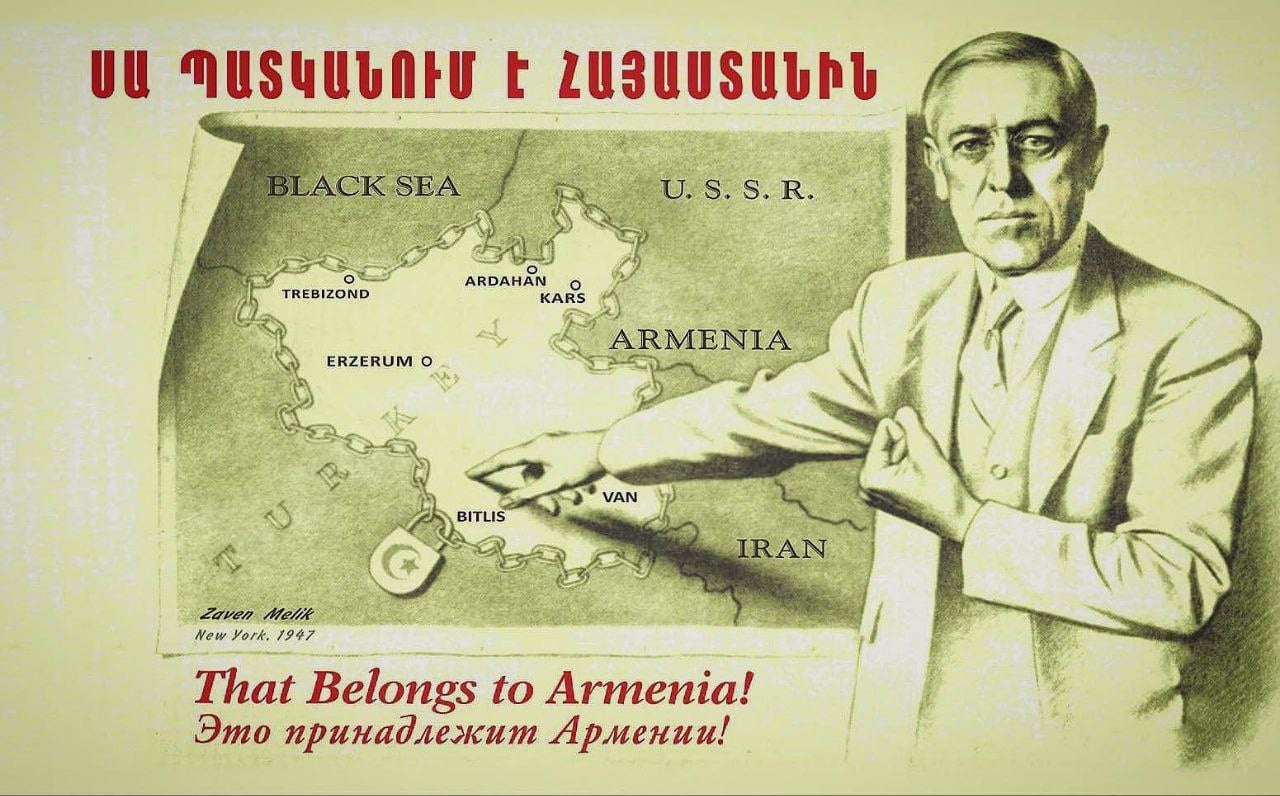
The Paris Peace Conference of 1919–1920 became one of the most important stages in determining the postwar order of the Middle East and the future of the Ottoman Empire. The question of Armenia occupied a special place in these discussions. The United States initially considered the possibility of significant involvement in the affairs of the Ottoman Empire and Armenia, but American policy gradually encountered serious financial, military, and domestic political constraints.
The Beginning of the Paris Peace Conference
At the beginning of 1919, U.S. President Woodrow Wilson was cautious regarding the Armenian question. Washington sought to strengthen its position in the territories of the former Ottoman Empire, maintaining close relations with Great Britain while simultaneously keeping a conciliatory tone in its contacts with Russia.
At the same time, Wilson did not want to expose the American army to new risks or assume significant financial obligations for the sake of a devastated Armenia, whose reconstruction required enormous investments.
On January 18, 1919, during an important conversation with Boghos Nubar, the U.S. president opposed independent official Armenian representation at the conference. Wilson explained his position by stating:
“The civilized world will protect their interests as diligently as if they were doing so themselves.”
During this period, the leaders of the Entente reached a general understanding: the European powers would force the Ottoman Empire to sign a peace treaty, while the United States could act as a mediator and arbitrator in determining the new border between Turkey and Armenia.
On January 30, 1919, a resolution was adopted providing for the separation of Western Armenia from the Ottoman Empire. At the same time, Wilson showed interest in a possible American occupation of Constantinople or Mesopotamia. Armenian delegations, however, feared that the United States might lose interest in Armenia if it did not receive a broader mandate over Transcaucasia. Alexander Khatisian wrote in this regard:
“Otherwise, they may not be interested in Armenia alone.”
Wilson and the Idea of an American Mandate
In the spring of 1919, discussions about a possible American mandate became more concrete. On March 20, Wilson openly discussed the possibility of the United States accepting a mandate over the entire Ottoman Empire. The plan involved separating the six Armenian vilayets and Cilicia.
On April 17, 1919, Wilson received the Armenian delegation consisting of Alexander Aharonian, Boghos Nubar, and Alexander Ter-Akopian. During the meeting, the president made a highly optimistic statement:
“If America ever accepts a mandate for any country, it will certainly be Armenia. …I am trying to secure for your people territory in the dimensions you desire and… I hope to succeed. …Your question is developing very favorably.”
These words created expectations among the Armenian leadership of extensive American involvement. Aharonian reported to Yerevan:
“British troops will not entirely leave our country until the Americans come to replace them.”
However, on May 5–6, Wilson began to show much greater caution. He pointed out that he did not have the authority to make such a decision on his own and that final approval would have to come from Congress. The president stressed that he could not “make a decision now as to whether the United States can take the mandate.”
Wilson also insisted on unified administration over the whole of Turkey. Consequently, on May 13–14, various options continued to be discussed, including the possibility of placing Armenia and Constantinople under a single American mandate.
The Decline of American Enthusiasm
In the summer of 1919, the initial American enthusiasm began to decline noticeably. At the same time, domestic political opposition in the United States to further American involvement in European and Middle Eastern affairs was growing.
On May 21, plans for American control over the Straits, Western Armenia, and Cilicia were discussed. However, on June 26, Wilson rejected the issue of the Bosporus, which was of major importance to the proposed Armenian mandate.
On July 1, Herbert Hoover stated that an American mandate could only be implemented in connection with Mesopotamia, since the status of the Straits was directly connected with Russia. At the same time, the United States decided not to take active measures until the “complete and very careful determination of the geographical boundaries” of Armenia.
The problem was not limited to foreign policy. American public opinion and Congress were increasingly reluctant to accept the possibility of sending troops and assuming new financial obligations.
On August 12, Ambassador James Davis noted:
“The permanent stationing of American troops… is impossible from a military and political standpoint.”
On August 23, Secretary of State Robert Lansing also pointed to the financial and political obstacles:
“There are no funds available for such a purpose. …The attitude of a number of senators, as well as their hostility toward the President and everything he advocates, is so strong that an appeal to Congress would only add fuel to the fire already raging.”
Meanwhile, the Armenian government continued to rely on foreign assistance. On July 11, Alexander Khatisian appealed for assistance in supplying 30,000 Armenian soldiers.
The Harbord Mission and the Rejection of Military Commitments
In the autumn of 1919, American policy definitively began to shift toward rejecting large-scale military commitments.
On November 1, General James Harbord submitted a proposal for negotiations with Ankara. His mission examined the possibility of an American mandate and estimated its potential cost at approximately $756 million. According to the mission's calculations, its implementation could require as many as 200,000 troops for a period of five years.
These figures demonstrated the scale of the commitments the United States would have had to assume.
The Senate's decision dealt another blow to the prospects of American involvement. On November 19, 1919, the Senate rejected the Treaty of Versailles, significantly limiting the president's ability to pursue a foreign policy connected with the European postwar settlement.
Earlier, on October 10, warnings had been voiced during hearings in the United States that even a temporary deployment of American troops to enforce the future Treaty of Sèvres could lead to war with the Turkish nationalists:
“Even the temporary introduction of American troops to enforce the future Treaty of Sèvres would constitute a casus belli and would inevitably lead to a massive Turkish attack at any convenient moment, even without hostile actions on the part of the Armenians.”
The Armenian leadership continued to request at least military assistance. On January 7, 1920, Armen Garo wrote to Robert Lansing:
“It is indefensible and extremely cruel on the part of the friends of Armenia to deprive us of the means of self-defense if you yourselves are unable to protect us.”
Recognition of Armenia and Wilson's Arbitration
In the spring of 1920, American policy took a different direction: the United States was prepared to recognize Armenia diplomatically, but not to assume military obligations for its defense.
On March 19, the Senate finally rejected the proposed mandates over the Ottoman Empire. However, on April 23, 1920, the United States recognized the government of the Republic of Armenia.
On April 24, Alexander Aharonian proposed extending Armenia's borders to Erzincan, arguing that Armenian forces were capable of capturing Erzurum themselves if provided with sufficient weapons, ammunition, and moral support from the Allies:
“The Armenians were quite capable of capturing Erzurum themselves if the Allies provided sufficient weapons, ammunition, and moral support.”
On April 26, the San Remo Conference invited Wilson to act as arbitrator in determining the Armenian-Turkish border.
On May 17, the president agreed to assume this role. On May 24, he appealed to Congress to grant the United States a mandate over Armenia. However, the U.S. Congress did not support the initiative. According to Aharonian's assessment:
“Wilson, fully understanding that his proposal would necessarily be rejected, …nevertheless appealed in order to relieve himself of responsibility.”
On June 1, 1920, the Senate rejected the mandate proposal. As a result, Wilson was effectively left with an arbitration function.
The Treaty of Sèvres and the Armenian-Turkish War
During the summer and autumn of 1920, the arbitration process continued against the backdrop of the rapid strengthening of the Turkish national movement.
On August 6, Secretary of State Bainbridge Colby explained the delay in preparing the decision by stating:
“The study and examination of various historical and cartographic documents… required sufficient time.”
On August 10, 1920, the Treaty of Sèvres was signed between the victorious Allied powers and the Ottoman Empire. The treaty provided for the recognition of Armenia as an independent state and referred the question of the Armenian-Turkish border to Wilson's arbitration. However, the final decision on the border had not yet been issued.
The Armenian side continued to warn the Allies of the growing threat, emphasizing that the republic was effectively “fighting for its existence.”
On September 28, 1920, the Armenian-Turkish War began. By that time, the arbitration report was already nearing completion.
On November 22, 1920, Woodrow Wilson signed the arbitral decision, known as the Wilsonian arbitration award on the Armenian-Turkish border. The document was based not only on historical and ethnographic considerations but also took economic factors and security issues into account. It also provided for the creation of a demilitarized zone.
However, the decision was issued after the beginning of the Armenian-Turkish War, under circumstances in which the military and political situation had already changed dramatically. The United States was neither prepared nor politically capable of enforcing the decision by military means.
Conclusion
Between 1919 and 1920, American policy toward Armenia moved from discussions of a large-scale mandate over the Ottoman Empire toward limited diplomatic support and international arbitration.
At the beginning of the Paris Peace Conference, Wilson considered the possibility of extensive American involvement in the affairs of the Ottoman Empire and Armenia. In the spring of 1919, he even publicly contemplated accepting a mandate over Armenia and promised to help establish territory for the Armenians “in the dimensions you desire.”
However, financial costs, the need to deploy substantial military forces, opposition in Congress, changing American public opinion, and the lack of political consensus within the United States gradually made a full-scale mandate practically impossible.
Ultimately, the United States recognized the government of the Republic of Armenia but did not assume an obligation to defend it militarily. Wilson agreed to act as an arbitrator and signed his decision on the Armenian-Turkish border in November 1920. By the time it was signed, however, the Republic of Armenia was already at war with Turkey, and the international situation was changing rapidly.
Thus, American policy toward the Armenian question combined diplomatic recognition and support with a gradual retreat from direct military and financial commitments. This gap between diplomatic intentions and the ability to implement them in practice became one of the defining features of American policy toward Armenia after the First World War.