Copy-trading on Solana.
Get rich or die tryin`.

The crypto bull market of 2024-2025 is in full swing, and one of its biggest drivers and narratives has been... memes.
Meme coins (or shitcoins) took over the crypto space at the end of 2023 and haven’t slowed down since. From Solana’s resurgence and all-time highs, to the PumpFun phenomenon, to memes on TRON, TON, SUI... and practically anything you can name. Every blockchain scrambled to grab a piece of the hype.
Amid this frenzy, copy trading emerged as a hot trend. In simple terms, it’s about replicating the trades of profitable traders. Why spend all your time analyzing the market 24/7 to snag a few multipliers when someone else can do the heavy lifting, and all you have to do is follow their trades? This growing demand led to a wave of useful tools, making copy trading a "plug-and-play" approach.
And with massive trading volumes now concentrated on Solana’s DEXs, copy trading offers everyone—willing to put in the effort—a chance to make solid gains.
Starter Pack:
Where and how to find profitable traders’ wallets?
Starter Pack
In this section, we’ll go over free tools (mostly Telegram bots) that are essential for making copy trading a smooth and efficient experience. These tools handle most of the work when it comes to wallet discovery, analysis, and even automating trades. Without them, the process could quickly turn into a headache.
Pro tip:
It’s a good idea to create a new Telegram account specifically for copy trading. Alternatively, organize everything into a dedicated folder within your existing account for easy access.
So, what should you add to your toolbox?
Trading Bots:
TradeWiz

A free trading bot designed specifically for copy trading. The main advantages are fast transaction speeds and reasonable fees. If you're just starting out with copy trading, this bot will definitely be a Must Have.
Bloom Solana

A great free bot, mainly used for regular trading, but it also offers copy trading features. It shows impressive transaction speeds and low fees.
Wallet Discovery Tools:
To analyze a wallet and start copying its trades, you first need to find the wallet. Currently, there are about 100 million active addresses on the Solana blockchain. Naturally, manually finding a worthwhile address is nearly impossible.
So, here are the tools I use to search for wallets:
SmartWalletsSol
A bot that sends you a random Smart Wallet address upon the command /Wallet. It then provides links to analyze it further. The advantage is that it gives only one address per request. It's currently in test mode, with a limit of 30 requests per day per account.
Shit101 Parser
A parser that searches for wallets based on the filters you provide (tokens you send). It can also request migration lists from PumpFun. There’s a paid version available as well.
An alternative (though not as good) would be searching for wallets on websites like DexScreener and GMGN. On DexScreener, you can view the "top traders" tab for token information, and GMGN has a section for smart wallets.
Wallet Analysis Tools:
Once you've found a wallet, you need to analyze it. For that, you can use specific services and blockchain explorers.
Zelfiguru on Solana
A fantastic service that shows wallet statistics for the past month—profit, win rate, ROI, number and quality of trades—basically everything you need. You can also export the stats to an Excel file. We use it regularly. The free version allows 3 checks per day, but the paid version is much cheaper than competitors, so it’s worth purchasing. The premium version also includes the ability to export wallet data for the last 24 hours based on your filters, which could replace the wallet search step. Plus, the premium chat provides access to profitable wallet selections and smart money signals. It’s hands down the best service for analyzing Solana wallets.
SolSqueezer
A solid second-choice tool for wallet analysis in Telegram. It provides similar stats to Zelfiguru and offers good Excel visualizations. The prices for paid plans feel a bit steep, though. The free version also gives 3 checks per day.
dEdge
A new player in the wallet analysis software market. The free version allows 5 scans per day (or 15 over 3 days). The minimum subscription costs 0.1 Sol per month, which gives you 20 scans per day. For 0.5 Sol, you can also use their API and create your own tools. The downside is that it’s the slowest of the three options.
Summary: You get 11 free scans per day (from a single account). Scaling up is possible. However, ideally, you’ll want to purchase a paid version for more scans and features.

SolScan
A blockchain explorer used for more in-depth transaction analysis, checking wallet transactions, fees, and tracking the flow of funds when necessary.
GMGN
This is the second time I’m mentioning this site. For those who prefer doing everything in the browser, you can even copy trade through GMGN. I use it because it’s super convenient for viewing wallet transactions in their table format. Overall, their dashboards are great.
Wallet Tracking
This is a crucial step in the process, I'd say it's the most important one. Wallet tracking means monitoring the actions of a wallet. You input the wallet address into a bot and receive notifications if the wallet does something. I recommend setting up notifications for only buys/sells and transfers over 1 Sol, to avoid spam.
Ray Bot
A great option. The free version allows tracking up to 10 wallets (scaling up is easy, as we know 😎).
Drops
Another tool for tracking up to 20 wallets on the free plan. Essentially, you can use both bots on a single account and track up to 30 wallets. This should be plenty to get started.

Where and How to Find Profitable Trader Wallets?

Now, let's get to the main task. First, we need to find wallets to analyze. To do this, we’ll use a bot or a parser to get smart wallets.
Using the Bot
Simply send the command /wallet in the bot, and it will give you a random wallet address. You can then follow the links to immediately start analyzing it.
Using the Parser
The parser requires a bit more effort, and you'll need an IQ of 20 or higher. First, let's set up the filters. Go to the “Парсинг тут” section and type /settings@shit101pars_bot to open the settings.

Parser Settings Example:
Here’s how I’ve set mine up:
- min bal (minimum wallet balance): 1 Sol (we’re not interested in empty wallets)
- min WR (minimum win rate): 60% (this is the minimum threshold for profitable trading)
- min ROI (minimum ROI): 40% (anything less isn’t worth it)
- min trades (minimum number of trades): 5 (to exclude those who got lucky with a single pump)
- period (time period for stats): 30 days
- max fast trades (maximum number of “quick” trades): 30%
- min % rockets (minimum % of trades with ROI > 100%): 5%
Additionally, enable the checkboxes at the bottom for further settings.

Once the filters are set, type /start@shit101pars_bot, and you can start sending contracts for checking in the following format:

Wait a few minutes, and you’ll get the results in a table format.

Parsing Results
You can filter up to 250 wallets per day through the parser and 30 via the bot. With paid subscriptions, you can do this endlessly.

Sample Wallet List for Analysis
Now, you have wallet addresses and their basic stats, which means you’re ready to move on to the next step—analyzing them.
How to Analyze Wallets?

Now that we’ve gathered the wallets, we need to choose the ones suitable for copy trading. This is where the services and bots from the first section of the guide (Zelfiguru, SolSqueezer, dEdge) come in handy.
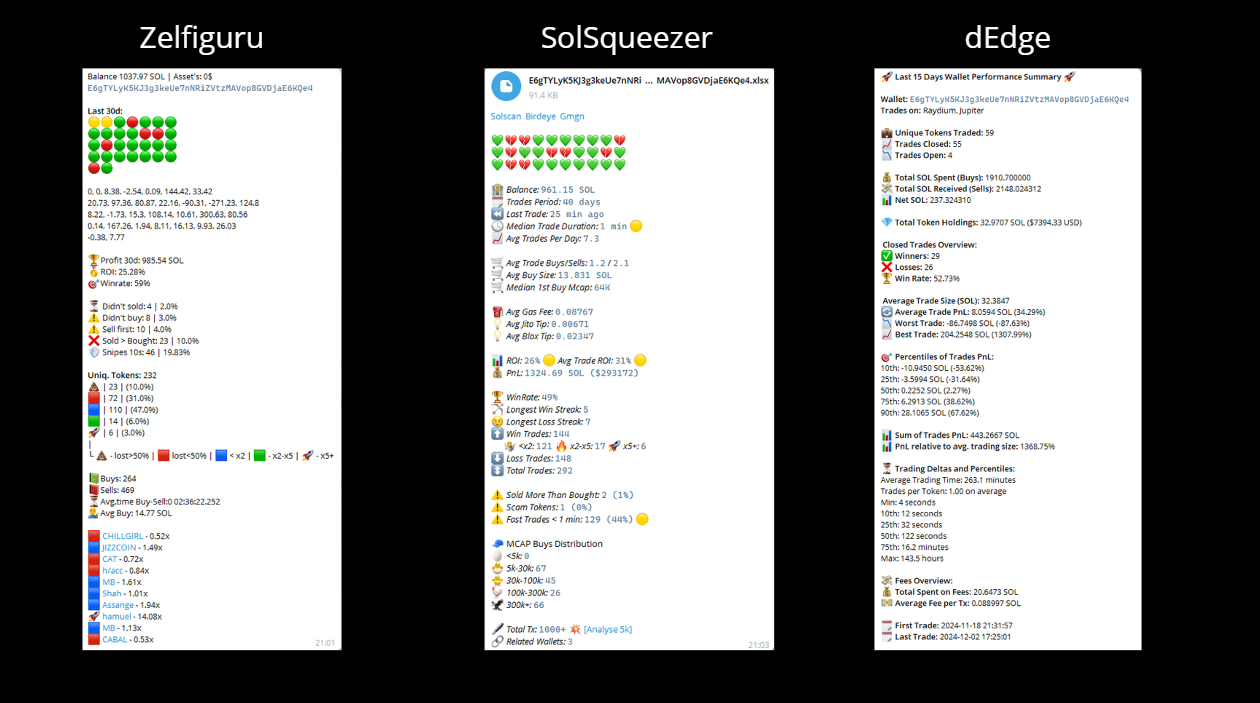
We’re looking for certain behaviors in the wallet to determine if it’s worth copying:
Example of Analyzing a Random Wallet across Three Bots
The numbers may vary, but the general idea is the same.
- The wallet performs a small number of trades per day (not a bot or gambler). I usually look at a range of 1-7 trades. This can be seen in bot tables. GMGN is also great for reviewing transaction history.
- The transaction size is under 10 Sol.
- Win rate > 60%.
- Sales happen at least a couple of minutes after the purchase (this isn’t a strict rule, but if it’s a scalp for a 10-20% profit, we might end up in the negative).
- The wallet sells tokens only when the profit reaches at least 50%. Otherwise, commissions and poor entry points might push us into a loss.
- The wallet doesn’t snipe (doesn’t buy tokens when they are listed). This can be checked in wallet analysis bots.
- The wallet doesn’t average down (it buys a token once).
- The wallet isn’t copy trading (sadly, it’s not just you searching for wallets). This can be verified in the bots or by looking at the order book on DexScreener/GMGN.
If the wallet matches most of these points, it’s ideal for copy trading, and you could earn money passively. However, finding such a wallet is difficult, and do you really need to find the perfect one? If a wallet meets most criteria but not all, you can adjust your trading strategy to fit.
I’ve Chosen Wallets, What’s Next?

Next, we need to save the wallets in a special list in notes or a table on your computer. Keeping track is crucial. This will become your database. It’s also a good idea to give each wallet a detailed name like:
"Trader | 80% WR | 100% ROI | Buys during dips, sells in a ladder pattern."
Now, add the wallets to your tracker (refer to the first section) and monitor their actions for at least a day. During this time, you should assess whether the wallet fits your needs. Here's what you do:
- If you see the wallet buys a token, wait for it to sell (first sale).
- Check the chart and estimate: if you had entered just a few seconds later and sold at the same point, would you have made a profit (taking fees into account)?
- Make conclusions about whether copying this wallet is worthwhile.
- If the outcome is positive, add the wallet to your trading bot and start copying.
Strategies

As I mentioned earlier, each wallet behaves differently, and therefore, you’ll need to copy them in various ways. Here are a few possible scenarios:
- The wallet buys in multiple transactions (averaging down) and sells in one when it’s in profit.
- A) You can manually look for an entry point after the wallet makes its first purchase, expecting a dip.
- B) You can set up the bot to replicate multiple purchases or all of them with a fixed amount or percentage, and sell along with the wallet.
- The wallet buys a dip and sells in a ladder pattern after reaching a certain profit.
- A) Fully copy its actions by setting up a ladder sale based on percentage, just like it does.
- B) Copy the purchase but disable the sales function, selling manually when you reach your desired profit percentage.
- The wallet enters deals excellently but sells everything at a 2x, while the tokens keep going up.
- A) Fully copy its strategy (because hey, a 2x is still profit).
- B) Copy the purchase but disable the sales function and sell manually at your desired profit percentage.
- The wallet snipes but only with top tokens that go on to explode.
- A) Try copying the entry, increasing your commission and bribe.
- B) Just track the wallet and, knowing it picks quality tokens, find your own entry point.
- The wallet is a bot, entering scam tokens with 2-3 million cap.
These are just a few scenarios for dealing with various types of wallets. You can create your own convenient strategies and find approaches to nearly every wallet. The key is experience and creativity.
Money Management

In any form of trading, it’s crucial to properly manage your funds. Here are a few key points:
- Starting Capital: I’ve seen people start with almost no deposit—just $10-50—and make it big. However, you’ll feel much more comfortable with a couple hundred dollars, or better yet, $500 with a premium subscription to tools like Zelfiguru.
- Amount per Trade: It’s no secret that entering a trade with your whole deposit isn’t the best idea. Ideally, divide your deposit into 20 parts (or 30-40 if it’s large) and only risk 1/20 on a single trade. On the beginning stages, I recommend not copying too many wallets at once. Stick to 1-3 reliable wallets that do fewer trades so you’re not stuck with half of your deposit in a single trade.
- Money Should Work for You: If you entered with $10 on a $200 deposit, there’s no point in continuing to use the same amount when your balance increases to $1000. Increase your investment proportionally.
- Money Should Bring You Joy: As a wise person once said, “Set it, take it.” If you don’t withdraw profits into real life and just get caught up in boosting your balance, you will burn out eventually. Treat yourself to some sushi or bigger purchases now and then.
Useful Tips
Here are a few random but useful tips:
- Once you hit a good level, don’t trade from just one wallet. Periodically switch it up or use multiple wallets. Always transfer funds through exchanges to avoid people copying your trades and draining your wallets.
- Set limits for the minimum capitalization of tokens you buy, otherwise, you could be tricked (the wallet buys pump tokens with small caps and dumps them on you).
- Burn tokens and return Solana for transaction fees on services.
- Don’t underestimate SolScan. Learn how to use it well. With decent knowledge of it, you’ll have a big advantage over those who don’t use it.
- Keep a trade journal, track your profits by day, week, and month. Write down your mistakes and try to correct them.
- Stay updated on news, updates, and new software. The market is constantly evolving, and new tools can be a huge help—be the first to learn about them.
- Don’t skimp on premium software—it really saves a lot of time and opens up more opportunities.
- Find like-minded people—it’s always nice to have someone to discuss your trading strategy with.