THE DRIVING TECHNIQUE FOR SINGLE-SPEED KARTS EXPLAINED BY JOSEPH TURNEY
° DRIVING POSITION
“It is better not to invent anything in regard to the installation of the seat and mount it following the standard measurements indicated by the manufacturer. In fact, these dimensions are designed to ensure that the centre of gravity is in the optimal position for the specific characteristics of the chassis. Eventually, you can change the stiffness of the material: a softer seat is usually combined with hard tyres and a harder seat with soft tyres.
This does not mean that the driving position cannot be as comfortable as possible. To achieve this, adjust the footrest and the height of the steering wheel so that you have your arms and legs bent: an angle between 130° and 140° is ideal. You must be able to push as hard as you can to turn the steering wheel: the driving style to be adopted with single-speed karts, as we will see later, requires driving as cleanly as possible and pulling the steering wheel towards you to steer, as some drivers do, is not a good idea because it affects driving precision”.
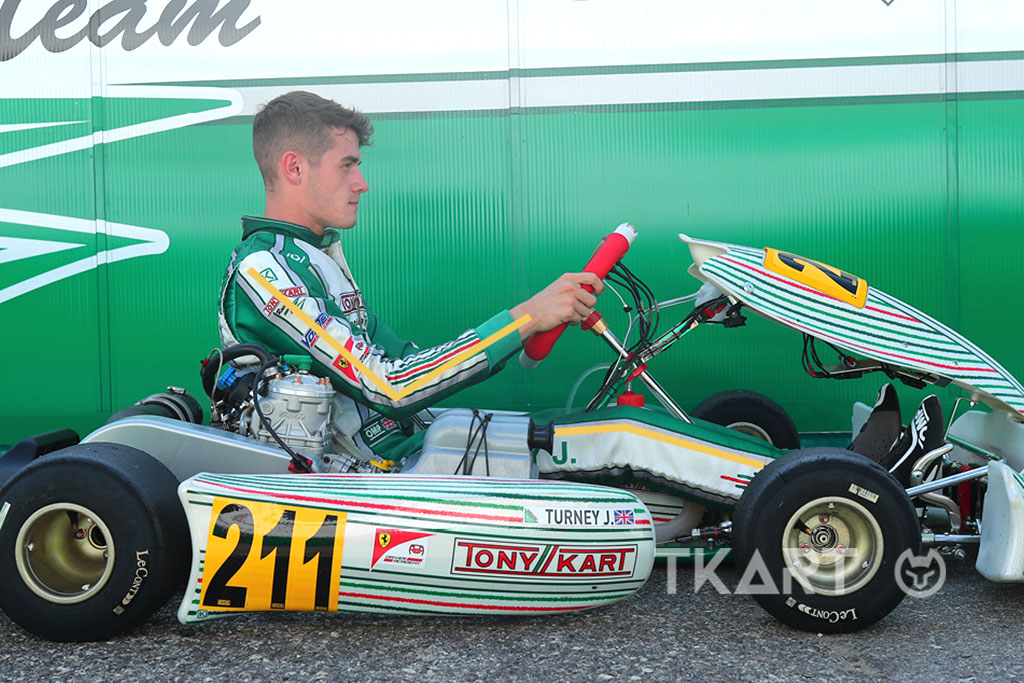
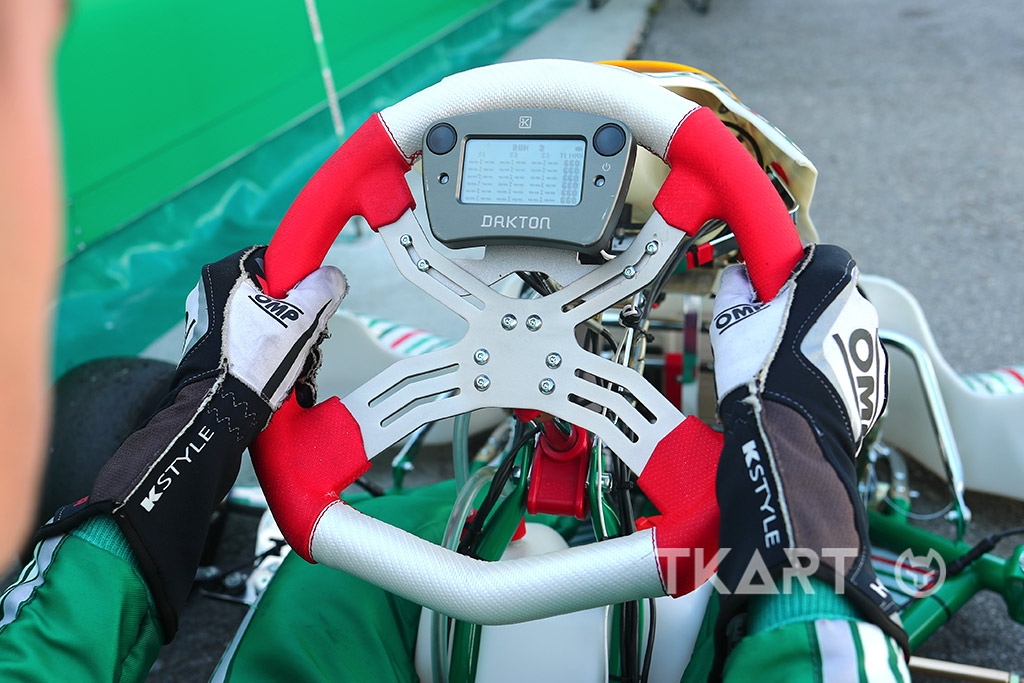
Hands should be placed at 9 and 15.
2° TRAJECTORIES AND DRIVING STYLE
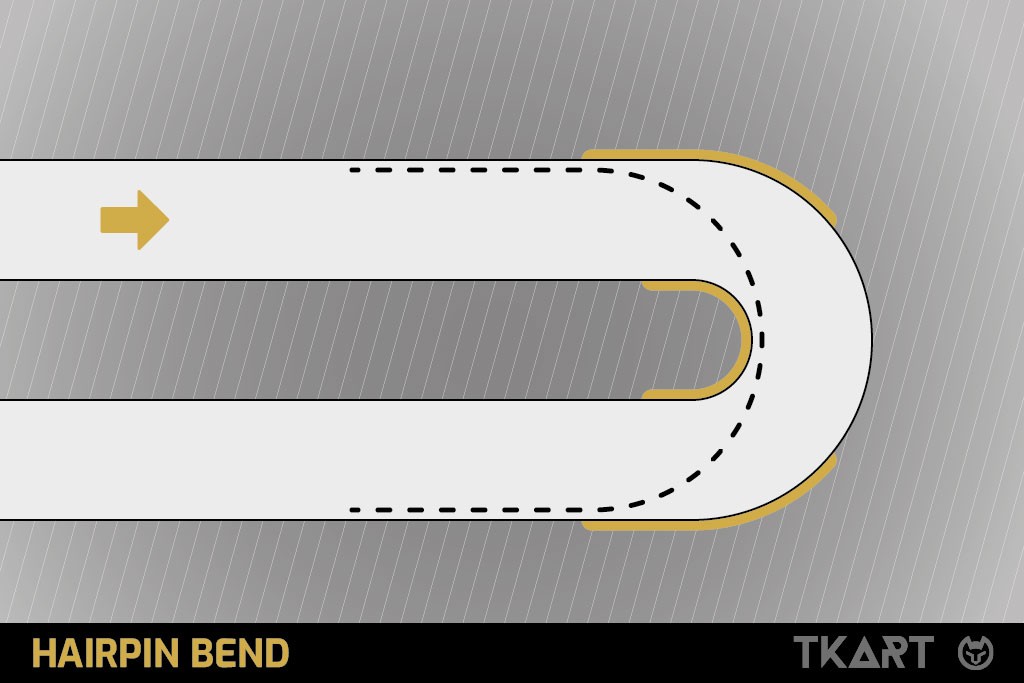
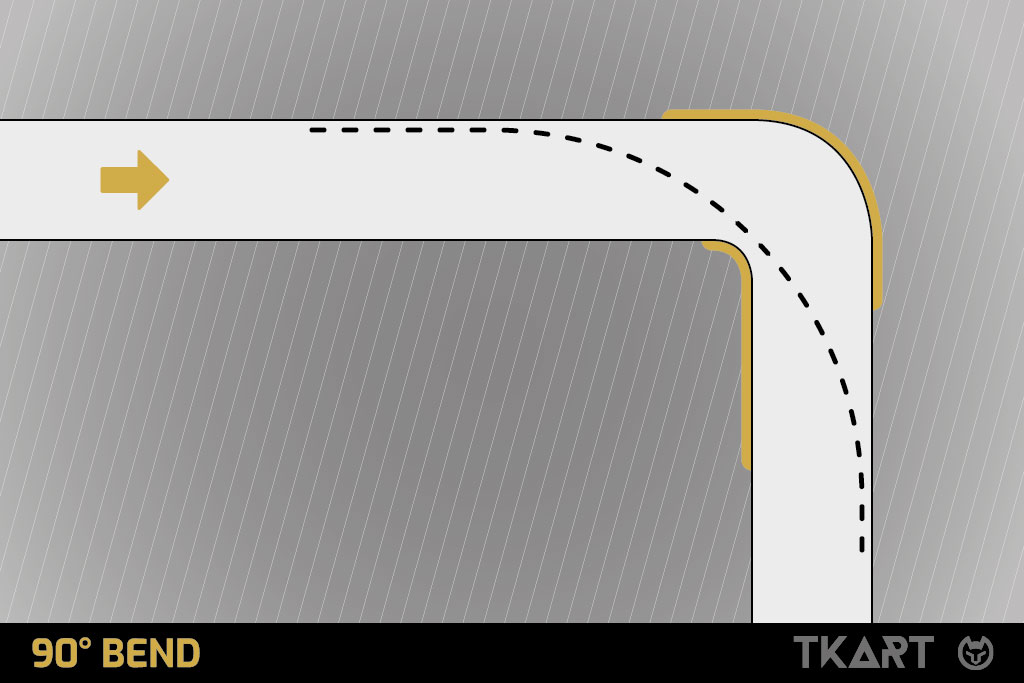
“As is common knowledge, when driving single-speed karts, it is essential to be careful not to let the engine speed drop too low so as not to get stuck coming out of bends. The goal is therefore to draw trajectories that allow you to keep the engine in torque and, at the same time, not go too far. In addition to very round and wide trajectories, you must try to drive as cleanly as possible (that is, you must avoid oversteering), especially when the asphalt is very hot. At high temperatures tyres tend to slip, overheating occurs and, therefore, you lose performance. The result? You will find yourself no longer having any grip when cornering, or to be in the phase in which the difference is made between going fast or slow in karting”.
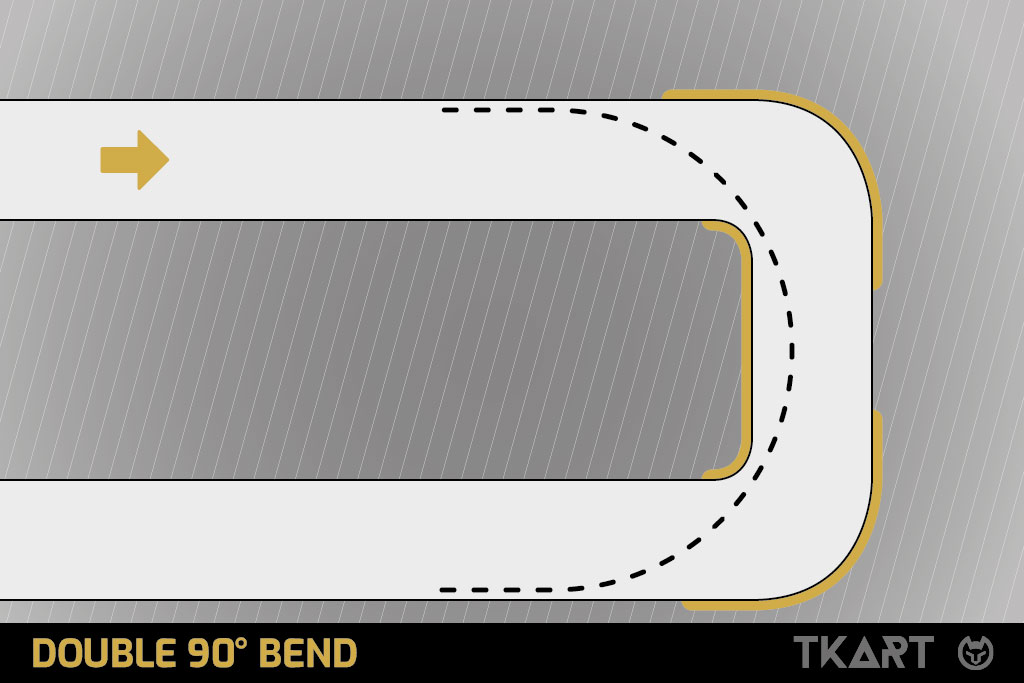
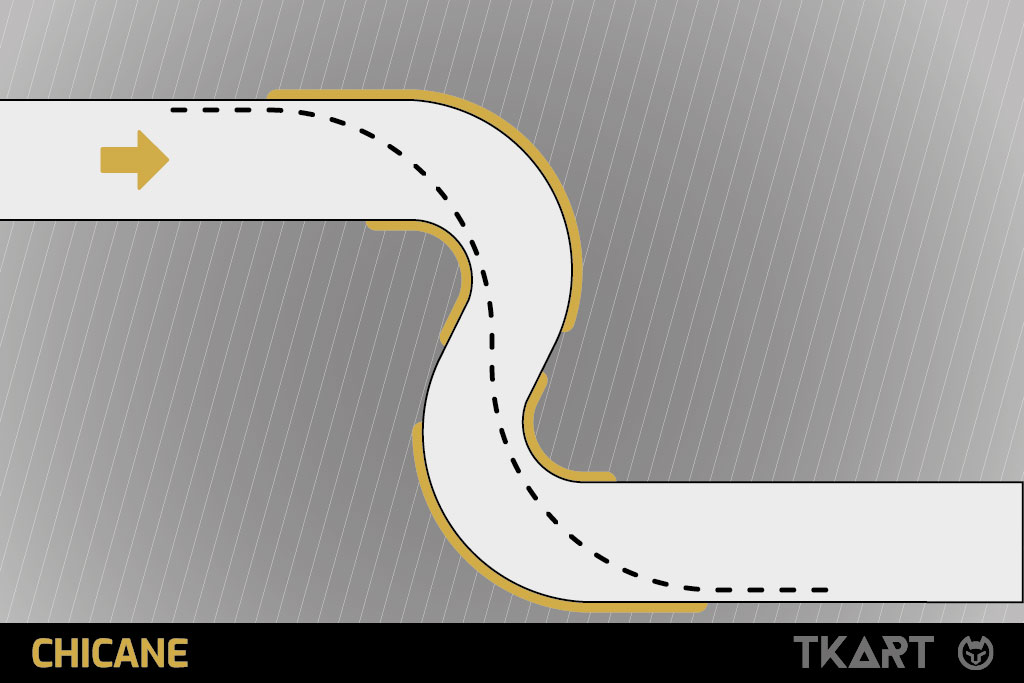
These pictures show the ideal trajectories for four different types of bends: hairpin bend, 90° bend, double 90° bend and chicane.
3° BRAKING
“Braking is a crucial part of driving single-speed karts which, let us remember, do not have front brakes. First of all, when braking with the kart going straight it is normal to slightly block the wheels. Indeed, if these rolled without slithering, the kart would not slow down enough. In the case of a hairpin bend, a double 90-degree bend or a chicane, the technique to be adopted is as follows: brake as hard as possible before steering to take advantage of all the available grip and then reduce the load as you turn the steering wheel. Let's say that with 10° of steering the load is reduced to 75%, with 20° to 50% and with 30° to 25%. On a fast bend, such as a 90° one, you should usually brake only for a short stretch with the kart going straight, keeping the load on the pedal. During braking, an attempt should also be made to trigger a slight cross-over of the rear, but not in tight hairpin bends where the engine rpm would otherwise drop too low. In these cases, oversteering must never be excessive: if you see that you have to give more than 20° of counter-steering then the rear is oversteering”.
On the same bends analysed above, here is how much load to apply on the brake pedal: the red line indicates braking at the limit of the rear wheel lock, while the load on the brake pedal is reduced in the orange section.


On a “square” bend, the brake pedal release pha... Read more


The points where the RPM an speed graph drops r... Read more

4° ACCELERATION
“Acceleration must never be totally on-off because when driving a single-speed kart, in which, again in order not to let the engine speed go down, you have to start accelerating even before reaching the clipping point, being too abrupt can result in a spin. When I think about it, no bends come to mind where I accelerate past the clipping point, except when driving on a wet track.
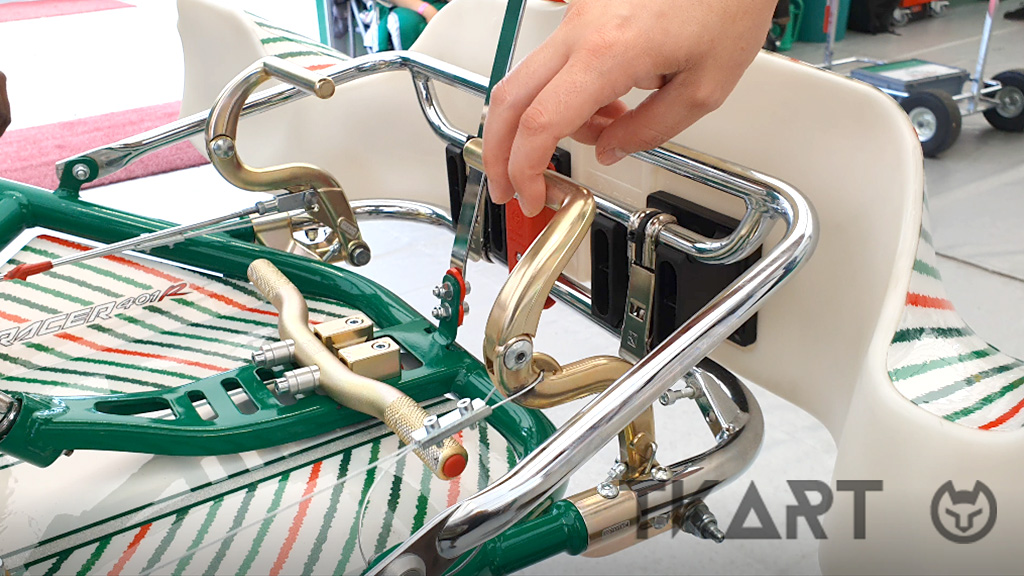
As for the accelerator pedal, it is better to leave a little play (as seen in the video, editor's note) when connecting the cable to the carburettor. If it is too tight you can inadvertently accelerate due to the vibrations or every time you go over a bump or a curb”.
When and how to accelerate? The point where the light green section begins is where you start to accelerate while you have to completely press down on the accelerator pedal from the point where the dark green section begins.


In the case of a very narrow chicane, accelerat... Read ore

5° LET'S REVISE EVERYTHING
Editor's note: let's now put all the information relating to trajectories, braking and acceleration together.

6° CARBURETION
“It is untrue that you never take your hands off the wheel in single-speed karts! You don't have to change the gears, this is true, but you have to pay attention to the carburetion. Like during the start, which occurs in motion at low speed. With the engine running very low, you need to make sure you get a good start and to do that you have to play with the carburettor's idle screw. You have to make the carburetion lean (i.e. reduce the percentage of mixture in the intake), so as not to flood the engine at the start.
When you are at the end of a long straight, unless you want to overtake, it is instead good practice to have a richer carburetion (i.e. increase the percentage of intake mixture) in order to reduce the risk of engine seizure”.
To get richer carburetion, a technique also useful for keeping temperatures under control, do not adjust the carburettor, but instead cover the air inlet holes in the filter with your hand. But you have to do it right. Step 1: your foot must still be on the accelerator and your hand on the steering wheel.

Step 2: place your hand on the filter (until yo... Read more

Step 3: remove your hand from the filter only b... Read more


7° ON WET TRACKS
“Things change radically when it rains. For a start, you can no longer use the dry track trajectory because tyres left on the ground becomes really slippery on a wet track: you would not be able to stop the kart or turn on bends. Your approach therefore becomes much more angular and the metres travelled while braking, which occurs with a kart going almost completely straight and therefore applying a constant load, can even triple. With a very low grip, it is then necessary to find a way to increase the lift of the inner rear wheel to steer the kart. In regard to the setup, there are usually four solutions: you can raise the kart at the front and rear to move the centre of gravity upwards (in order to have more load transfer to the outer wheels); the front track widens; replace the axle with a softer one; tighten up the rear track to the limit allowed by the regulations (the wheels must not 're-enter' with respect to the fairings)".
With more angular approaches and low travel speeds, you have to ensure that the engine immediately picks up speed: this is why the wet sprocket (on the left) can have 6/7 more teeth than the dry one (on the right).

In the photo, the coloured signs represent trajectories, braking and acceleration points for the usual four bends, but on wet tracks (shown in light grey dashes, for reference purposes). In the first case (the hairpin bend), driving is almost always on the outside to spend as little time as possible on the dry track trajectory.
On the fastest bends, you should try to stay within the dry trajectory by passing over the curbs. Only after crossing them can you accelerate.
You have two options for the chicane bend. One is widening as far as possible when entering the second bend, which is preferable when the chicane is followed by a long straight.1 di 2

8° THE SET-UP
The standard set-up of the Tony Kart Racer 401 R in dry and wet conditions.
STANDARD SET-UP FOR DRY TRACKS
Camber neutral or 1 negative hole
Toeopen 0,5 mm per side (1 in total)
Fairing supports not excessively tightened
Seat supports 2 on the brake side and 1 adjustable on the engine side
Centre bearing tightened and then loosened if necessary
Toe open 0,5 mm per side (3 in total
Fairing supports not excessively tightened
Rear width the maximum allowed in rain conditions by the regulations: flush with the fairings
Seat supports Support screws slightly loosened
Centre bearing tightened, loosened if necessary
Engine / transmission one less sprocket tooth, if it rains a lot you can also have 2 more teeth for the gear wheel

Joseph Turney, born in 2001, is a professional international kart driver. Among the best results achieved during his career were the victory at the IAME International Final 2018 in the X30 Senior and, in the same year, the BNL Karting Series in the Rotax Max Senior. In 2019 he moved to the Tony Kart Racing Team with whom he w