THE CORRECT MAINTENANCE OF CHAINS, GEAR WHEELS AND SPROCKETS
THE CORRECT MAINTENANCE OF CHAINS, GEAR WHEELS AND SPROCKETS
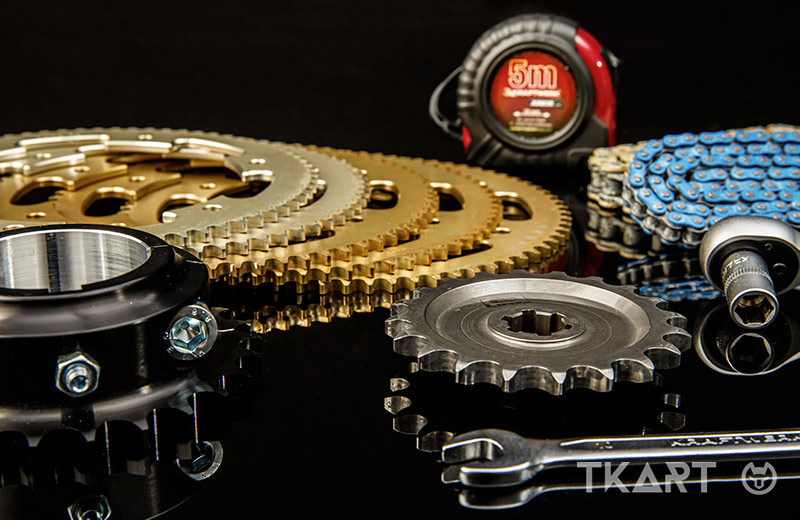
The kart’s transmission consists of a chain, gear wheel and sprocket. Elements that we all know but which, unlike other vehicles, for example bicycles or motorcycles, are subjected to greater stress due to the forces involved and the absence of flexible couplings. The common mistake is neglecting maintenance and not knowing how to recognize the alarm bells that necessitate the replacement of a worn component. It must be said that a transmission failure, for example the chain breaking, can also affect the engine. In the case of engines without a rev limiter, an overspeed could occur with consequent damage to the connecting rod which would therefore be replaced with certainly higher costs than those that can be incurred to keep the chain-gear wheel-sprocket fully efficient, thus reducing this type of fault and damage.
So let's see the correct procedures to always have an efficient transmission.
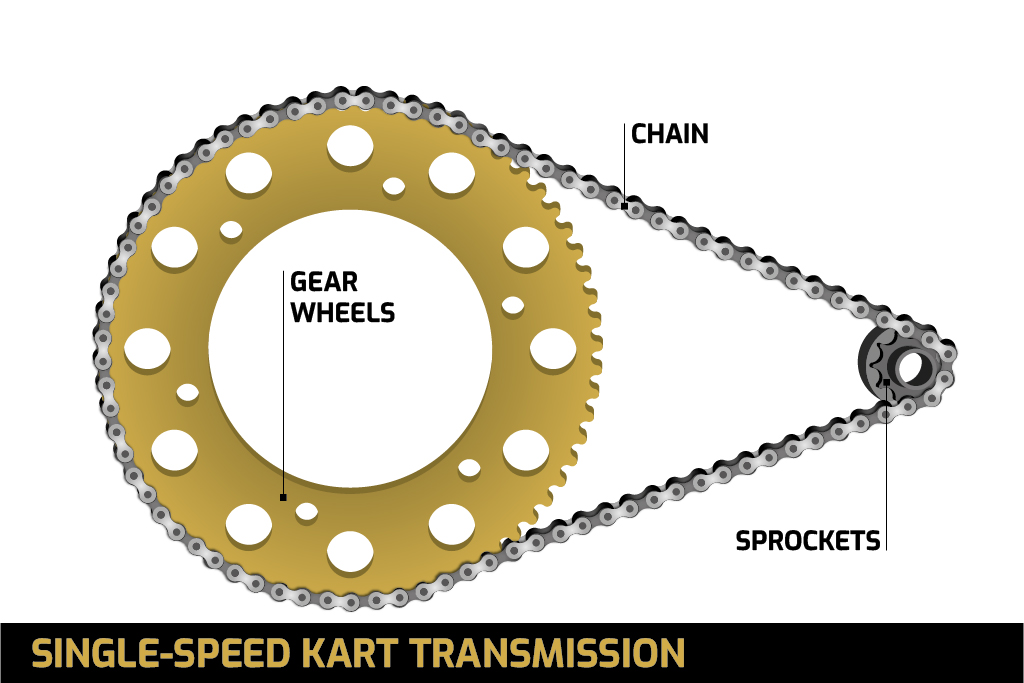
The kart transmission consists of a chain, gear wheel and sprocket. However, depending on whether it is a single-speed or shifter kart, these elements have different shapes and sizes.
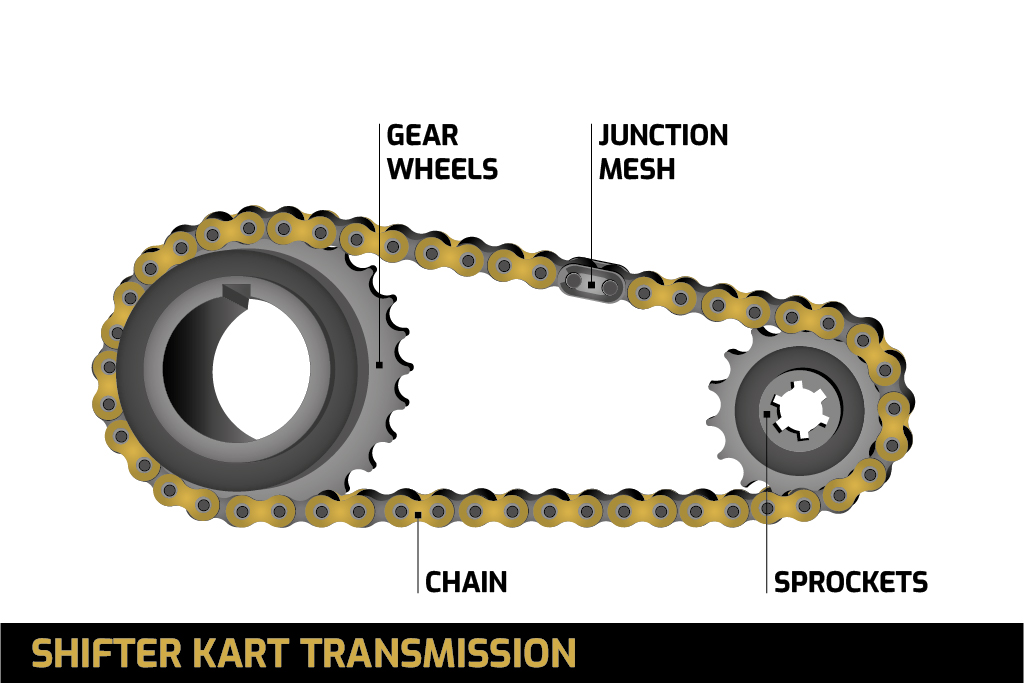
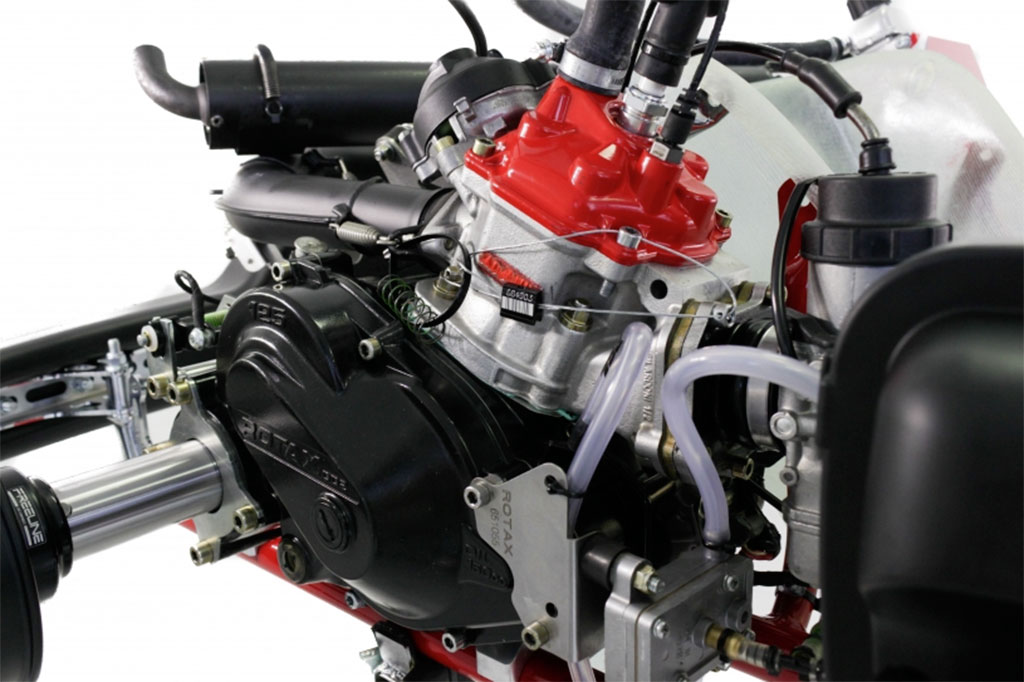
Then there is another type of transmission: this is the one adopted only by the Rotax DD2 engine, which does not have a chain gear wheel and sprocket, but has the through axle directly inside the crankcase. Obviously, not all the indications given in this article apply to this type of engine. Photo credit: PSL Karting ...Read more
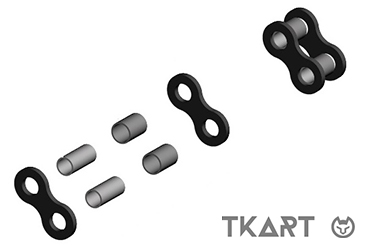
Two types of chains are used for karts, one for single-speed engines, called the 219 series, and one for the gear motors, the 428 series. The two types differ in the length of the wheelbase and internal width, but are composed of the same elements. In detail, the chains are composed of two parallel series of plates (internal plate and external plate) with two offset holes, connected by a pin. A bush is inserted around the pin which crosses the inner plate and allows lubrication along the pin. A roller is mounted on the bush, enclosed by the internal plates. The roller is the element that absorbs most of the force exerted by the sprocket to transfer it to the gear wheel teeth.
There are chains with O-rings between the inner and outer plates; this set-up allows continuous lubrication of the elements and prevents the penetration of external agents (dirt, earth, dust, etc.) which affect the duration of the chain. Chains with O-rings increase friction and reduce power to the wheel. These are low values, but their use is recommended with engines with powers above 30 HP, where the duration of the chain is put to the test. Conversely, in engines with less horsepower, for example in the single-brand or in the 60 cc of the MINI, a chain without an O-Ring is recommended, making the transmission smoother.
The 219 series chains are available in different lengths, depending on the number of links they are made of, generally from 98 to 110.
The chains used in kart shifters (428 series) have bigger links to withstand the forces to which they are subjected and can be modified in length by using a special tool on the connecting link, the chain extract and "chain mesh", to eliminate/add links. The junction mesh is recognisable due to the presence of a double external closing plate, which allows the opening and insertion of links to increase the total length. The variation is always of two meshes (a pair of internal plates and one of external plates). The chains have an even number of links.
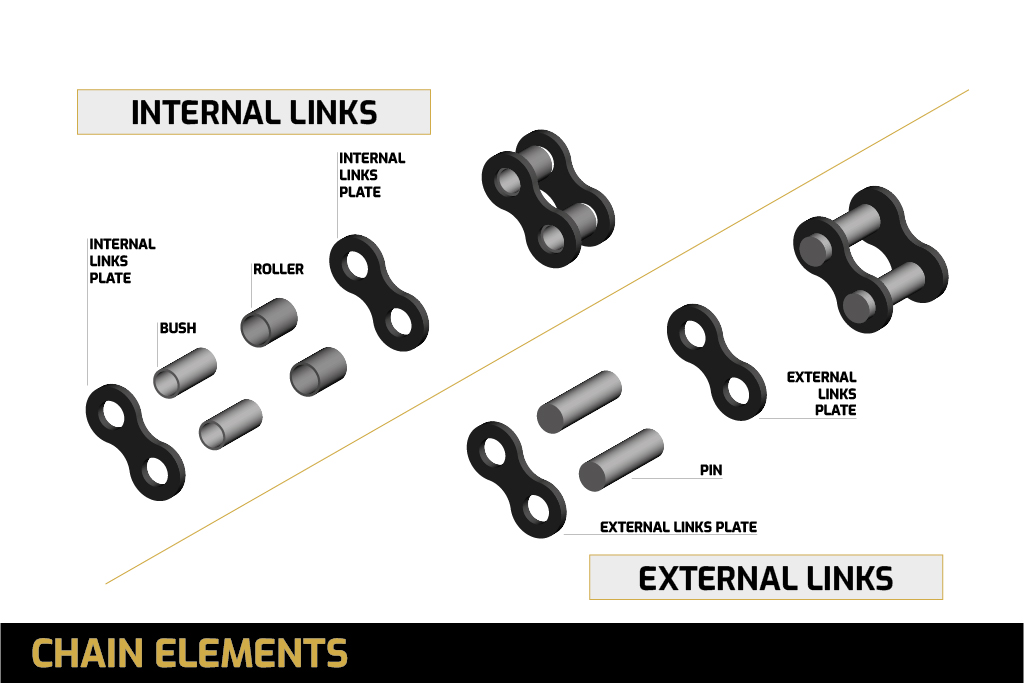
Two types of chains are used for karts, one for single-speed engines, called the 219 series, and one for the gear motors, the 428 series. The two types differ in the length of the wheelbase and internal width, but are composed of the same elements.
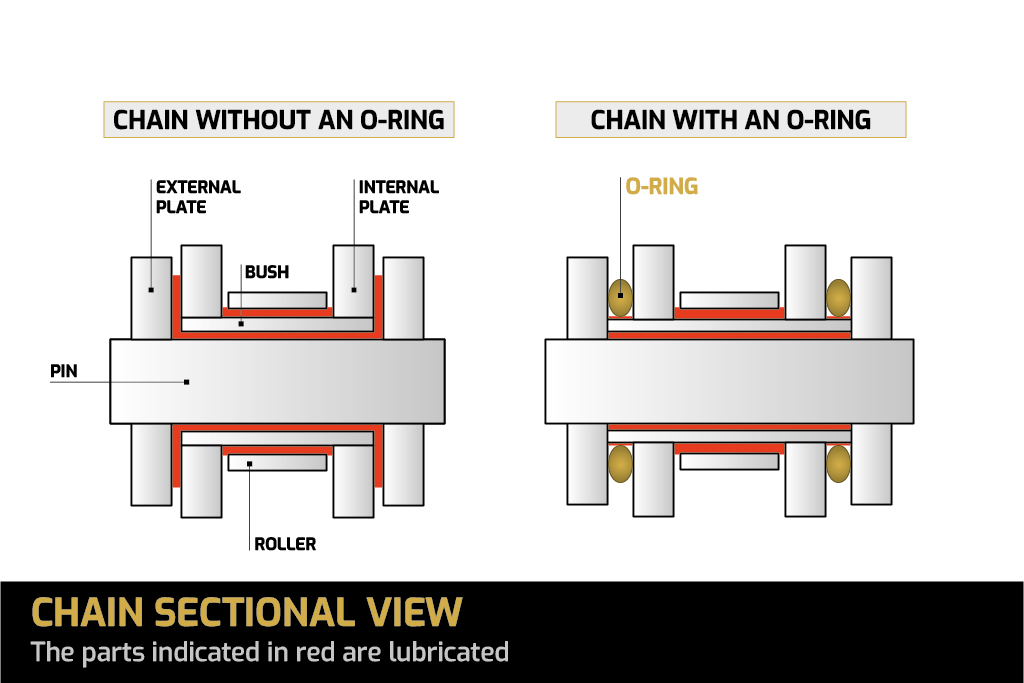
A chain with an O-Ring prevents the entry of debris between the chain’s components, extending its duration. Its use is recommended in engines above 30 HP where the greater friction caused by the OR does not affect performance.
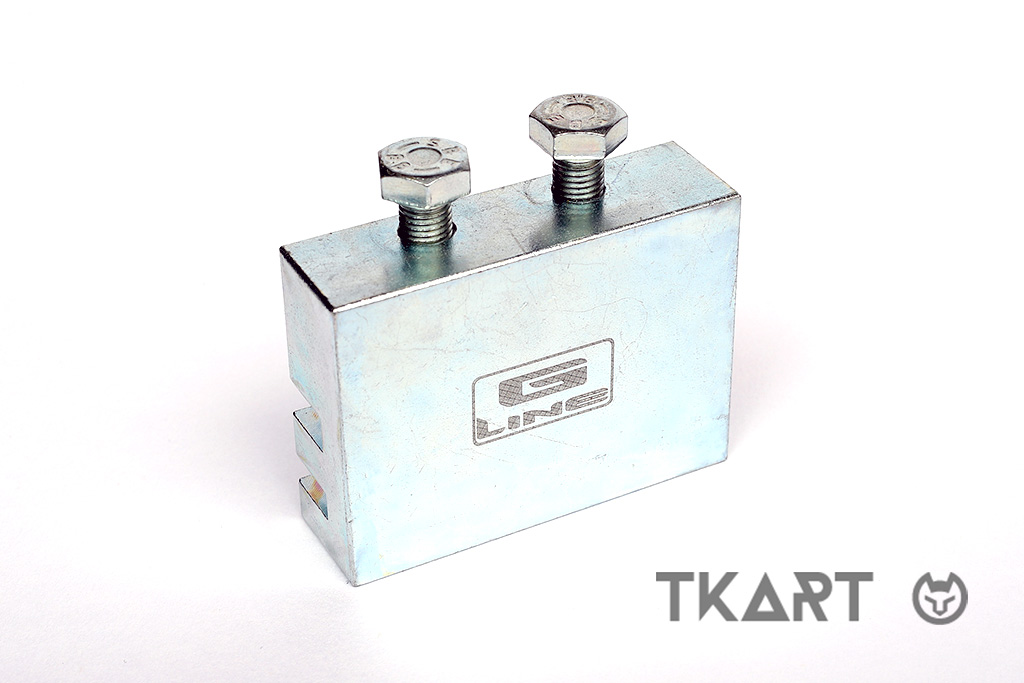
An example of a 428 series chain puller for Shifter karts. The chains for this type of kart, unlike the 219 series (for single-speed karts), can be lengthened and shortened by adding links or removing excess links using the tool in the photo.
CHAIN - PRODUCTS FOR LUBRICATION
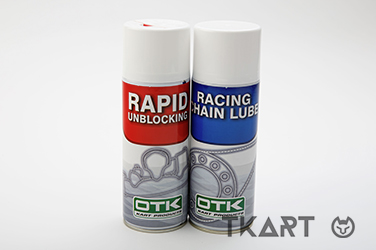
Lubrication must be performed with products expressly indicated for use. The best products are synthetic with the addition of ceramic additives. These components allow excellent adhesive capacity of the product on the chain and great penetration into the links as well as a low viscosity variation as the operating temperature varies.
Absolutely avoid the use of "general use" products, such as WD40. These products are excellent stain removers and unblockers but have a formula with low lubricating power; this means a dry chain after covering just a few metres. In addition, there will be no cleaning action between the roller and the bush of the chain, with the elimination of the lubricating grease.
We recommend the use of "dry" grease which is preferable to the less modern "stringy" grease. The latter generates much more foam and dripping/splashing of excess product. It also tends to attract debris more easily which will worsen the sliding of the chain, speeding up wear with the possibility of premature breakages.

On the left, the “dry” grease spray. On the right, instead, the “racy” type, more dated and less suitable for karting.
CHAIN - WHEN AND HOW TO LUBRICATE
Lubrication is carried out as soon as a round on the track is finished. With the chain still hot, the grease will easily penetrate inside the components, improving their lubrication. In chains with O-rings, the lubricant will only enter between the bush and the roller and will have a protective effect on the rubber pads, while in those without O-rings, the grease will also reach the pin and the bushing, forming a protective film that prevents dirt from entering.
It is important to make sure that the grease is sprayed not only in the middle of the chain but also on the side links and along its length. This activity is facilitated with the kart positioned above the trolley with the chain guard removed. Before entering the track for the next round, if you warm up the engine on the trolley, remember to apply the grease again.
After a day on the track, remove the chain from the kart and immerse it in a basin with petrol. If you have a chain with an O-Ring, avoid using petrol for washing, which is harmful to the rubber pads, but use diesel fuel instead. At this point, brush the chain to remove the debris collected on the track, without using metal brushes.
During a test day, if you want to clean the chain quickly between one round and the next, because maybe you exited the track and collected dirt, you can use specific spray cleaners.
Spray the grease on the side links and in the middle of the chain for proper lubrication.

There are several products on the market for quick chain cleaning, without necessarily having to dismantle it.

Proper maintenance of the chain is an activity that limits its wear, but the chain is still an element to be replaced periodically. At an amateur level, the replacement of the single-speed chain (series 219) is recommended after four days of practice laps. While for the KZ chain (428 series) you can complete about ten outings without worries. One of the parameters to check to determine if a chain is at the end of its life-cycle is its lengthening. To evaluate it, you can use a tool that indicates if the chain is still usable or if it is better to replace it. Elongation is acceptable when it does not exceed 1% of the total length in chains without O-rings, and 2% in chains with O-rings. A worn chain exponentially increases the wear of the gear wheel, dissipates engine power and has a high possibility of breakage.
Note for kart drivers who race: it is good practice to change the chain at the end of the day. It should not be thrown away, but can be used in private tests or practice laps later on. Changing it daily or at least in the morning before a final is a good idea to avoid any breakdowns in the most important phase of a competition.

There are several tools to measure the elongation of the chain. The one pictured has two different measures per side to evaluate the condition of the chain.
Chain tightening is not adjusted randomly. In single-speed karts and Mini karts, a chain that is too tight will lead to greater wear on the gear wheel and a real possibility of damaging the crankshaft. Conversely, if it is not tight, the chain may exit its housing and cause a stoppage along the track and, in a race, withdrawal.
To achieve the correct tightening, you need to measure the oscillation halfway between the gear wheel and the sprocket. You can check this with a ruler, measuring the movement of the chain from the lower dead centre point to the upper one. Set a measurement of about 15 mm in single-speed karts while 10 mm is sufficient in shifters.

Chain tightening varies between single-speed karts and shifters. In the former, set a length of 15 mm of oscillation, while 10 mm is sufficient for shifters.

For a chain of a single-speed engine that is too tight you can break it. The recommended slack is about 15 mm.
GEAR WHEEL - WHEN TO CHANGE IT
Gear wheels, like chains and sprockets, are wear-and-tear elements of the transmission. In the single-speed classes, the gear wheel is four millimetres thick and its wear is much faster compared to that of KZ karts. The wear of the gear wheel is speeded up by an elongated chain which needs therefore to be replaced, or by an incorrect alignment with the sprocket. In the former case, you can notice it by observing the shape of the hook teeth in the upper part. In the latter case, with the gear wheel and sprocket not aligned correctly, the anomalous wear can be seen on the side of the gear wheel where the chain rests outside its optimal housing. In single-speed karts which exit tracks or pass over a high curb, the gear wheel must be checked to see if it has been damaged. In this case, just turn the wheels and ensure that the chain is tightened along its entire length, otherwise the gear wheel will have to be replaced. To safeguard the gear wheel and prevent the chain from falling, you can mount a gear wheel protection kit. This accessory consists of two discs to be attached to the sides of the gear wheel and has the task of absorbing impacts against curbs.

The presence of hook teeth is a clear sign of a chain that needs to be replaced.

The incorrect alignment of the gear wheel can be seen on the side on which the chain rests, outside its optimal housing.

In the single-speed karts, to safeguard the gear wheel and prevent the chain from falling, you can mount a gear wheel protection kit. This accessory consists of two discs to be attached to the sides of the gear wheel and has the task of absorbing impacts against curbs.

The alignment of the gear wheel is important to avoid the abnormal wear described above. This activity needs to be carried out when replacing the engine and when the chain or gear wheel or sprocket are replaced.
For single-speed karts, the most correct way to carry out alignment is to use the special laser pointer to be fastened to the gear wheel (even if in emergency situations and in the absence of anything else, alignment using a rod is also acceptable). The gear wheel holder not fastened solidly to the axle will allow you to move the gear wheel until the pointer is positioned in the middle of the sprocket tooth. Once you are sure of the position, you can fasten the wheel holder to the axle. In KZ karts it is necessary to be very careful in the fastening phase: the tightening screws of the two halves must be pulled leaving the same empty space between the two sides, to maintain the correct tooth spacing.

In KZ karts, attention must be paid when fastening the gear wheel to the axle: the tightening screws of the two halves must be pulled, leaving the same empty space between the two sides, in order to maintain the correct tooth spacing.

The alignment of the sprocket is important in KZ karts as well, but it can be done manually using a rod. What is shown in the picture is an example of misalignment as the face of the pinion is not square with the straightedge.

Although the laser remains the best choice, even in single-speed classes it’s possible to align the chain with a straightedge.
The alignment of the gear wheel to the sprocket is a simple activity but it must be performed correctly to extend the life-cycle of the gear wheel and make the transmission work in the right way.

Sprockets are the strongest element of the transmission. Unlike the gear wheel, which is made of aluminium, sprockets are made of steel and their hardness extends their life-cycle. By setting the right chain tightening and lubricating as described above, you should not worry about its wear. Conversely, a chain that is too tight and poorly lubricated will wear the teeth of the sprocket, so that it needs to be replaced.

Sprockets are the most resistant element of the kart transmission in all classes. Sprockets have different sizes and shapes depending on whether the engine is a shifter or single-speed. In the case of single-speed engines, there are different sprockets depending on whether or not the engine has a centrifugal clutch.