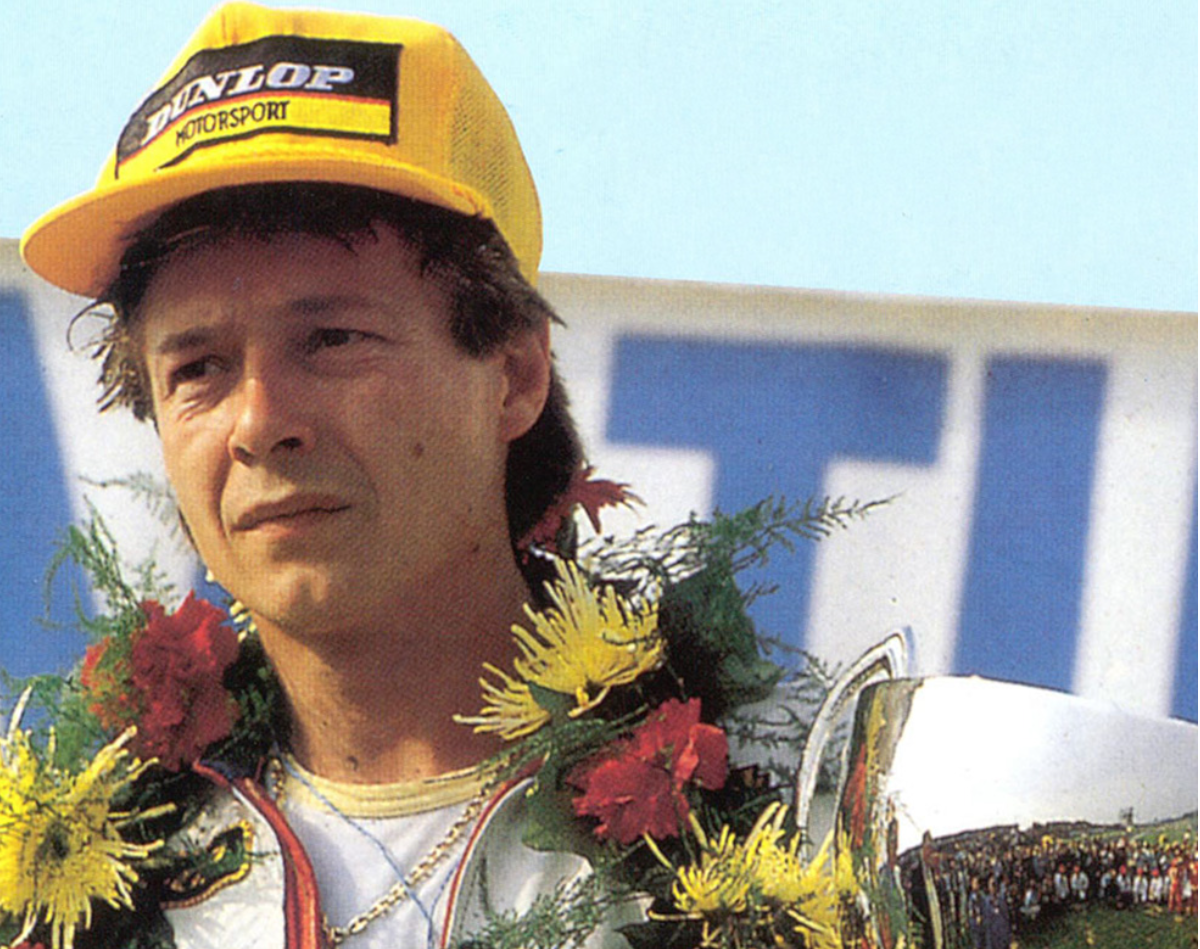
INTERVIEW WITH MIKE WILSON — KARTING’S GREATEST RECORD HOLDER
In karting history, there is only one true record holder: Mike Wilson.
The British driver is the only karting racer to have won six FIA Karting World Championships
(1981, 1982, 1983, 1985, 1988, 1989), all in single-gear Formula K 135cc categories.
This record remains unbroken — and stands as one of the longest-lasting achievements not only in motorsport, but in sport as a whole. Considering that today’s average karting career lasts only four to five seasons, it may well remain untouched forever.

Wilson’s achievements become even more remarkable when you consider the names he raced against — and beat — during his career: Ayrton Senna, Terry Fullerton, Alessandro Zanardi, among others.
In 1989, Mike Wilson decided to hang up his helmet.
But that decision did not mark the end of his love story with karting.
From champion to mentor
After retiring from competition, Mike dedicated himself to creating his own chassis line, sold under the MW brand between 1990 and 2006. These chassis were used by future Formula 1 World Champions — including Fernando Alonso — during their karting careers.
Later, Wilson became a full-time consultant, a role he still holds today within the Mercedes-AMG Petronas Formula One Team Driver Development Programme, where he has continued to shape careers by identifying and guiding young talents from karting to the highest levels of motorsport.
Names like Lance Stroll and Andrea Kimi Antonelli should sound familiar.

Today, Mike divides his time between the grandstands — carefully observing every move of the young drivers he mentors — and the team tents, where the real work happens: talking, analyzing, explaining, and most importantly, teaching a way of thinking.
Because his work is not only about driving technique.
Yes, few people in the world can explain how to take a corner or prepare an overtake better than Mike Wilson. But his real focus lies elsewhere — on communication and telemetry analysis.
Every driver must learn how to communicate clearly with engineers and how to interpret data correctly: where time is lost, why it happens, and how to improve.
The goal is clear — to build complete drivers, capable of progressing from karting through every level of motorsport. Hopefully, all the way to Formula 1.
The eye for talent
By 2025, Mike Wilson’s role is defined not only by the authority earned through his results, but also by a unique talent he has demonstrated for decades: spotting future champions early.
Over the years, he has helped develop drivers now racing in Formula 1, as well as emerging talents like Alex Powell (born 2007), who will compete in Formula 4 Middle East, Italian F4, and Euro 4 in 2025.
When asked which driver impressed him the most throughout his career, Mike answers without hesitation:
What stood out was not raw talent or personality — qualities Alonso has never lacked — but his clarity in problem-solving.
An unstable kart, changing grip levels, a mistake to correct — in every situation, Alonso found solutions, adapted, and remained competitive.
How it all began
Few people know how Mike Wilson’s story started.
He was eleven years old, camping with friends in the UK. It rained for days. When the sun finally appeared, the campsite had turned into a swamp — until someone discovered a nearby rental kart track.
At first, Mike didn’t even want to drive. His father already owned a kart, but Mike preferred playing football. That day, something changed. Once he went out on track, he fell in love instantly.
He spent all his money just to keep driving. With empty pockets, he called his father for more. His father came, watched a few laps, and asked a question that changed everything:

“Do you want us to buy a kart?”
The answer was obvious.
Soon after, father and son tested their first race kart. The debut wasn’t smooth — a flooded spark plug, then a crash into tire barriers, the visor flying fifty meters away. But neither of them gave up.
From that moment on, they travelled across the UK, racing almost every weekend — sometimes three races per weekend, over 52 races per year, for six straight years.
Senna, rivalry, and respect
Mike names Terry Fullerton as the most talented driver he ever faced — but one rival stands out above all: Ayrton Senna.
Wilson first saw Senna in Parma in 1978. Senna was driving with one hand while covering the carburetor intake with the other — something no European driver could replicate with such precision.
Their rivalry peaked in 1981 at the Champions Cup in Jesolo, where a collision sent Senna to the hospital and Wilson finished second with a puncture.
Years later, in 1989, during an FIA awards ceremony, Senna approached Wilson after his sixth world title.
“What you achieved is incredible,” Senna said.
Wilson replied modestly that it couldn’t compare to Formula 1 titles.
“In Formula 1 I race against one teammate and a few others. In karting, even reaching the final is difficult — you fight against thirty-two drivers. That’s the difference.”
Senna never won a karting world title — something Wilson believes remained one of his greatest regrets.

Why not single-seaters?
Why didn’t Mike Wilson move to formula cars?
He tested Formula 3, even with Prema, and showed immediate pace. But the problem was money. Karting paid the bills — but didn’t build capital. Formula 3 required around €120,000, which he simply didn’t have.
Perhaps fate chose another path — leaving Wilson in karting.
And by doing so, giving the sport its greatest champion.
Six world titles.
One record holder.
A legacy that still shapes motorsport today.