Speed secrets! See the Corner Through the Rear Axle
See the Corner Through the Rear Axle
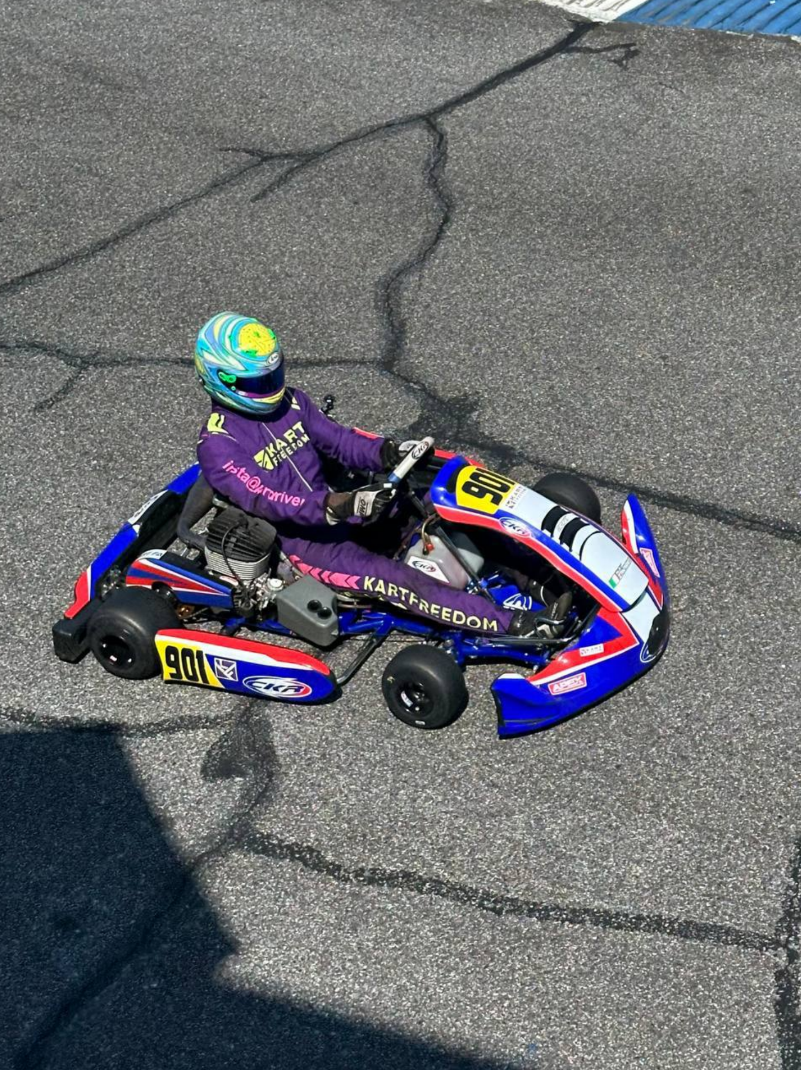
As coaches, we constantly ask you to brake later, turn in later, and steer more smoothly.
But what is behind those instructions? What do we actually want to see in a corner? What do we want you to feel and understand?
I know that saying it is much easier than doing it—especially at speed, with other drivers around you and only a fraction of a second to make a decision.
So I want to offer you a different way to look at cornering. It might help you understand our advice and recognize something you are doing yourself.
When you turn the steering wheel, you do more than point the front wheels. You help the chassis work and create the conditions that allow the whole kart to turn.
Think of your job this way: through the steering wheel and pedals, you control the load on the chassis—particularly how the rear axle works.
Why Think About the Rear Axle?
A kart has no differential. Both rear wheels are connected by one solid axle and rotate at the same speed. However, the outside wheel travels farther through a corner than the inside wheel.
For the kart to turn freely, the inside rear tyre needs to unload sufficiently. It may lift off the track or remain lightly in contact with it. The important part is reducing its resistance to the kart’s rotation.
Steering geometry, chassis flex, and load transfer work together to make this happen. Your inputs constantly influence that process.
So the question becomes bigger than “Where are my front wheels pointing?”
What am I doing to the load on the rear axle right now? Am I helping the kart rotate, or making it harder?
What Do We Want on Entry?
When we ask you to turn in later, we want you to approach the corner in a position that allows one purposeful entry, without unnecessary corrections.
Turning too early often creates a familiar sequence: you head towards the inside kerb, realize you will reach it too soon, open the steering slightly, and then add steering again because the kart is no longer following the corner.
Each adjustment changes the load on the chassis.
First, you create the conditions for rotation. Then you reduce them. Then you try to restore them—all within a very short time.
The same applies to braking. A later braking point alone guarantees nothing. We need your speed and balance at turn-in to allow you to establish direction and continue through the corner without fighting the kart.
We want a prepared entry: you know where you will turn, how fast you will be travelling, and what response you expect from the chassis.
A Sharp Response Does Not Always Mean a Good Entry
Sometimes a driver turns the wheel sharply, feels an immediate response from the front, and considers that a good entry.
But look at what happens after that first response.
Does the kart continue rotating steadily? Or does it slide, jolt, lose rotation, and require another steering input?
An abrupt input creates an abrupt change in load. Depending on the setup and grip, the chassis may react too strongly, become unsettled, or start oscillating.
Imagine that your task on entry is to unload the inside rear tyre in a controlled way and allow the chassis to take the load.
Do it quickly when the corner requires it—but understand the reaction you are creating.
Let the Chassis Finish What You Started
Once you have initiated the turn, the kart needs to continue rotating.
This is often where unnecessary hand movements begin: a little more steering, a little less, then more again.
Sometimes a correction is necessary. But if this happens repeatedly, you need to understand why.
Was your entry speed wrong? Did you turn too early? Did you load the chassis too abruptly? Or did you open the steering while the kart still needed the inside rear tyre to remain unloaded?
If that tyre takes too much load too early, the rear axle can begin resisting the turn. You feel the kart stop rotating and try to fix it by adding more steering.
But more steering does not always solve the problem. Sometimes it simply asks more of the front tyres.
Our goal is to establish the right balance on entry and let the kart use it, without constantly disturbing it with our hands.
On Exit, Bring the Tyre Back Under Load
Now the kart has completed most of its rotation. It is time to accelerate.
As steering angle and lateral load decrease, the inside rear tyre takes more load again. Your steering and throttle inputs need to work together during this transition.
If you snap the steering straight while abruptly applying the throttle, the balance can change too quickly. The kart may twitch, slide, or start hopping.
Hopping also depends on setup, tyres, grip, and track conditions. But we must check whether the driver’s inputs are contributing to it.
Here is a useful image: gently place the inside rear tyre back onto the track and let the rear axle drive the kart forward.
Feel how unwinding the steering frees the kart to accelerate.
If you are still using a lot of steering, fighting a slide, or dealing with hopping on exit, look at the earlier phases too. The problem may have started on entry.
Smoothness Means Managing Load
Being smooth does not mean every movement must be slow.
It means your inputs match what the kart needs at that moment. You create the load, maintain it for as long as necessary, and reduce it at the right time.
- How the kart takes the load on entry.
- How the rear axle allows it to rotate.
- When it begins resisting the turn.
- How unwinding the steering frees it to accelerate.
The steering wheel, brake, and throttle work together. Through them, you control the balance of the whole kart.
Do You Recognize Yourself?
At your next practice, choose one corner and examine it closely:
- Am I turning too early and then correcting my line?
- Does the kart keep rotating after my first steering input, or do I have to turn it again?
- Am I disturbing its balance by repeatedly adding and removing steering?
- What do I do immediately before the kart slides or hops?
- Do I unwind the steering progressively, or snap it back?
- Can I feel the kart accelerating freely?
Watch your onboard video and try to explain each movement of your hands. Why was it necessary? What happened before it? How did the kart respond afterwards?
And tell me: which corner makes you recognize yourself in this description, and what do you feel there?
I want you to connect instructions like “later,” “smoother,” and “less steering” with what the chassis is actually doing.
You point the front wheels, but a good corner requires understanding what is happening at the rear.